Top 50 Jazz Blog

Top 50 Jazz Blog

Friday, March 11, 2011

Collective bargaining: Threat or Menace? by Steve Provizer

You know the story: A guy is crawling on the ground looking for something under a lamp post. His friend comes up and says "Oh, is that where you dropped your wallet?" The guy replies," No, I dropped it over there, but this is where the light is."

So, America has dropped its wallet and instead of going off and finding some new source of light (solar-powered? cheap flashlight made in China? "alternative" media?) we are trying to find it under a lamp post that was bought and paid for by some very wealthy and powerful people. 

We actually have the choice to look elsewhere for our wallets (or for what you might call a reasonable explanation for our increasing impoverishment), but people seem to keep getting sucked into that highly controlled "staying-on-message" pool of light. What the hell is happening here?

Are we so much under the sway of the Myth Of Infinite Mobility that we continue to identify with the barons who are picking our pockets- the "winners" in our culture, the fulfillers of the myth? 

Have we come to a point that we believe so little in the intrinsic nobility of service to the community that the only people whose efforts we will support are those seeking a tax break so they can open a hog farm in a "right-to-work" state?

Does the Myth of the Rugged Individual hold sway to a degree that we have completely lost the sense of "there but for the grace of god go I?" and therefore hold no group responsibility for the fates of those whom fate did not bless?


Follow your dreams? OK, no problem, but please remember that our fates are intertwined. 

Also remember that just because you're paranoid doesn't mean you're not being followed.


Friday, March 4, 2011

"Ma Nuit En Enfer. Or, A Night at the Movies" by Steve Provizer

Hollywood movies suck. Not only that, going to a multiplex theatre is one of the most dispiriting, depressing and irritating experiences imaginable. Yet, it's one to which Americans are sado-masochistically drawn by the millions. It's especially piquant to plunge in just after you've seen the Oscars; like turning over a beautiful moss-covered log in the forest and having your hand covered with slimy larvae.

I had submitted to watching the Oscars only because I actually know a couple who made a movie that was nominated for best picture. I was curious to see someone of my ilk trying to pass in that glorious parade of narcissism, so I gritted my teeth and abided the endless car ads, the gruesome display of self-love and the singular lack of humor that marked the broadcast. A person's gotta ask: Does each winner really love his or her family that much? (actually, one noticed that it was only the men who gushed about that, not the women) And you know what else? Bob Hope was always stiff as a board. Finding 5 bits from him that were funny must have taken the editors half a day.

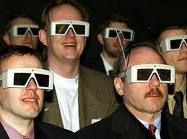
Right after that cavalcade of bonhomie, circumstances compelled me to transport my daughter to a multi-theatre gigaplex located in downtown Boston. The trip was necessary because video she'd submitted of herself singing one of Justin Bieber's  songs was chosen to get screen time in the "director's cut" (watch out Fellini) of his movie. It was about 2 seconds worth, as it turned out, but kudos to her. It was certainly Papabear's responsibility to get her there so she could strap herself in with the 3D glasses and bask.

I decided that the easiest thing would be to confer with my wife and find another movie that played at about the same time. It seemed a better alternative than drinking over-priced beer in the Theatre District for two and a half hours. Not the first time I've been wrong.

Walking in from the sidewalk, I knew immediately that we were in for an aesthetic treat. The interior of the place was right out of Albert Speers by way of Frederick's of Hollywood. The designers had managed to evoke mall anomie and blend it with the cheezy theatricality of Grauman's Chinese Theatre; all of it burnished with the accumulated grime of thousands of buckets of spilled popcorn smothered in "butter product."


Entering the theatre to see "True Grit" was like stumbling into a Mythbusters episode investigating how many decibels of sound it takes to induce diarrhea. We were forced to submit to half an hour of commercials and coming attractions-each of these pitched to 15 year old meth freaks. Bad in themselves, played at the volume level they were, they became instruments of torture. I'd paid Eleven and a half bucks to get the fillings shaken out of my teeth and have such of my hearing apparatus still remaining reduced to a distant tinnitus-tinged memory. 


I'll spare you a digest of the plot of True Grit. Initially, the experience was fairly pleasant, although the film's score was annoyingly Ken Burns-ish. However, as it went on, the characters more and more devolved into mere examples-albeit pristine examples-of "types." And, after the third bludgeoning, I asked myself how was it that crude, dismemberment/viscera-saturated violence had become so much the norm that it didn't even bear mentioning in film reviews?

While we're at it, someone tell me how many teachers can be paid union dues for the cost of one movie  ($300 million for "Avatar") and at what point filling out questionnaires at the end of a movie became electrodes strapped to your head.

No, my friend, the next time the latest "big" filmic release arises as a topic of conversation, you will find me curled up behind the couch with headphones on my head, a Rumpole in one hand and a Chateau Thames Embankment in the other.

Monday, February 28, 2011

Unions-Bah! What Are They Good For?

This past weekend, the motley musical crowd I play with-The Second Line Social Aid Pleasure Society Brass Band (SLSAPS)- played at a rally at the MA State House in support of Wisconsin unions-and unions everywhere(put into decent context here) and at a rally for the Student Farmworker Alliance and the Coalition of Immokalee Workers.

Maybe it was being around so many scrufulous people, or trying to play with frozen chops, but the whole weekend really turned around my attitude about unions. So, despite my ambivalence about such lists, I ask you to hearken unto my top 10 reasons why we just don't need unions anymore:
  1. No one's gonna tell me I can only work 8 hours a day.
  2. When my kid works, I want her to know the real meaning of money-no minimum wage for her!
  3. From 1990-2003, CEO salaries went up 272%, workers' went up 8%-definitive proof of basic Darwinian precepts (apart from Evolution, of course).
  4. Collective bargaining? Who came up with that idea? No matter how big or small the company, the CFO is always happy to individually negotiate your personal salary and benefits-and without any possible recriminations. Try it!
  5. I'm sure we would have had Social Security anyway.
  6. Workers in unions get 30% higher pay. Why should anyone without an MBA make more than me?
  7. If the average person made more, they'd just blow it on video games and condoms.
  8. Incomprehensible logos. 
  9. Calling each other "Brother" and "sister"- I mean, really.
  10. If left to their own devices, businesses-like banks-will certainly do the right thing by their workers.
                                               

Thursday, February 24, 2011

Orange Then Blue: Evanescent

Another video from the "Big Bands on the Edge" concert I produced at the Emerson Majestic Theatre in 1989, here is the group "Orange Then Blue," playing the song "Evanescent," composed by leader/drummer George Schuller. Some fine solo work by Ken Cervenka, Gary Valente and Stan Strickland.

With:
Matt Darriau-sax
Stan Strickland-sax
Allan Chase-sax
John Allmark-trumpet
Diego Urcola-trumpet
Ken Cervenka-trumpet
Mark Taylor-Fluegelhorn
Gary Valente-trombone
Peter Cirelli-bass trombone
Tim Ray-piano
Paul Del Nero-bass
George Schuller-leader/ drums
Sa Davis-percussion

Monday, February 21, 2011

"Boston Jazz Radio and Government Funding" by Steve Provizer

Looks like the NEA will cut the Jazz Masters program and government funding for PBS and NPR is in jeopardy. How will such cuts effect jazz? I'll just bite off a small piece of it and focus on Boston media.


There's little jazz on TV. Public television has a small stake, carrying awards ceremonies at the Kennedy Center, White House specials, a rare American Masters and the odd Ken Burns documentary. Mr. Rogers used to have great jazz guests. RIP Mr Rogers. Maybe Sesame Street does some. There's no homegrown jazz TV hereabouts. Some years ago, I tried and failed.

In Boston, radio's a different story. Jazz has a strong presence here and an NPR affiliate is one of the major players.

In sheer number of hours, the biggest providers of jazz programming here are WHRB-FM and WGBH-FM. WHRB runs jazz every weekday 5am-1 pm. It is the Harvard-affiliate and not a public radio station. 

There are a number of other college stations which have jazz programs. Jazz Boston.org lists them all, although the list is not necessarily up-to-date (2 of my defunct shows are still listed). Some of the hosts are college students who know little of the music, but some are knowledgeable community members and/or musicians.

WGBH, a powerhouse NPR affiliate, runs local jazz shows 8pm-midnight weekdays and overnight. Their jazz hosts are knowledgeable, if not very adventurous. Last year, WGBH shortened weekday jazz shows by an hour and swapped in a syndicated show for local DJ's overnights.

So what impact would the loss of funding have on local jazz radio? First of all, it would have no direct effect on any of the college stations-including WHRB's 35 hours of jazz a week and their orgy period, which often features hundreds of additional hours of jazz.

And WGBH?

A recent enormous build-out and move combined with the bad economy have forced WGBH to cut back on tv and radio programming budgets. Losing the c. $11 million they get every year from the govt. would be a blow. It's important to note that last year, WGBH made moves to seriously re-position itself in the Boston radio market. In order to challenge the primacy of WBUR-FM and its all-news and public affairs format, WGBH juiced up its talk, eliminated all blues and folk programs and off-loaded its classical programming to a station it acquired-WCRB-FM.

So, it seems a simple enough deduction that, given any significant shortfall in income, WGBH would continue its trajectory and only retain the syndicated overnight jazz programming. Their major jazz show, 4 nights a week, is Eric Jackson's "Eric in the Evening." This is the major shmooze spot for jazz musicians playing in the area. Not my cup of tea, but I think these interviews do help to get people into the seats of local venues(albeit usually the mainstream ones). If "Eric in the Evening" did shut down, local stations with stronger signals than college stations would probably readjust programming to try and grab some of that audience-a pretty desirable demographic.

So, I think the loss of Federal money would not affect the sheer amount of jazz radio programming in Boston. It could de-centralize the radio audience, which might have a democratizing impact on audiences, with higher end acts and venues possibly negatively impacted, but smaller venues getting a boost.

But this is just Boston- a unique radio situation. In many other markets in this country, Public radio provides music, news and public affairs programming that would otherwise simply not be available. I say Federal funding should continue, but that whenever possible, the money should be used to create or buttress local programming that would not otherwise exist in a particular market. 

Friday, February 18, 2011

Who is Art Tatum Dating? by Steve Provizer

Trying to figure out the saturation coverage of George Shearing's recent death; coverage equal to that given over to Billy Taylor. Taylor was a creative musician, not a musical innovator, but his work as activist/mentor/educator kept his profile very high. The attention made sense.

Shearing's sheer longevity may be vaguely at play here, as is the rarity of a jazz musician who sold millions of records. To my ears, Shearing's music is pleasurable and well-crafted but unexciting. He was capable of playing any style, but the chosen format of his most well-known groups was harmonically consonant and the soloing, while very adept, lacked edge.


Media exposure is the big player. Shearing, while blind, was a prodigy, white-British even-and a jocular pun-maker. In a hyphenated word: media-genic.

For comparison, let's throw Art Tatum into the equation.

Like Shearing, Tatum was blind and a prodigy, but Tatum's musical impact was widespread and unassailable.

Shearing was a quirky, but user-friendly public representative of the jazz world; one of a handful of jazz musicians who showed up regularly on TV. Tatum seems to have been something of a cipher. Comments on his music are many, those on his personality few. He was not photogenic.


Despite Tatum's musical contributions, there are very few obits in 1956, the year of his death. In fact, there are 2 different dates listed for Tatum's death: Nov 4th and 5th. You can throw some of the blame on jazz magazines, which are notoriously derelict at putting their old stuff online. Some gleanings:

Wikipedia deaths give you Lugosi, Brecht and Pollock, but not Tatum. Wikipedia Commons does list him.
A brief Jet Obituary
The Times Obituary of the era.
Jazz Monthly in Britain had an obit
A brief graf in Billboard

Apart from jazz websites, there are a couple of "modern" mentions of Tatum: One site says: "But even the passing of a giant such as Art Tatum didn't create much stir elsewhere in the world. The Presidential election was on most people's minds, the crisis in Hungary and the Cold War all grabbed headlines, relegating the death of this true genius to the back pages in the obituary notices."

I'm not sure the Cold War really explains it.

The other contemporary non-jazz site that references Tatum offers the vital information: Who Art Tatum is Dating.

So, will a media-genic musician will always draw more attention?
 
Stupid question.

Friday, February 11, 2011

"Ginseng People"-Woody Shaw Quartet

The music is sublime.

Woody Shaw-trumpet,  Stanley Cowell-piano, David Williams-bass, Terri-Lyne Carrington-drums,

8-21-85

Sordid backstory:
I still get pissed thinking of the SOB sitting next to me, whose cigar smoke you see wafting through the visuals, who refused to move his damn stogie 2 inches so it wouldn't blow into my mouth...

Sunday, February 6, 2011

A New Jazz Glossary of Tempos (Super Bowl counter-programming)


I offered "Tempo de Chet: as a substitute for Lento. Others:

Larghissimo=Ray Charles
Adagio= Pee Wee Russell
Andante=Benny Carter

Moderato=Red Garland
Allegro=Fats Navarro

Presto=Lionel Hampton
Prestissimo=Bird   

Friday, February 4, 2011

Frank Foster Quartet-4.10.85

Another in a series of videos I shot in the 80's and 90's, which have never been seen.

Foster, longtime soloist with (and eventual leader of) the Basie band, is a guy who devours changes. The rest of the group are no slouches.
Frank Foster-sax
Rufus Reid-bass
Kenny Barron-piano
Terri-Lyne Carrington-drums


It took Foster a long time to find his way to Wellesley College for this concert, so he improvised this title:"The Leaving New York On a Rainy Friday And Arriving at 5:15 at Logan Airport in Boston On a Rainy Friday and Having One Heck of a Time Getting to Wellesley Blues."


Tuesday, January 25, 2011

"Stereotypes in Black Music" by Alan Kurtz, reviewed by Steve Provizer


Author Alan Kurtz's thesis is: since at least the turn of the 20th century, African-American performers have been fulfilling and/or re-inforcing stereotypes of the naturally-rhythmic primitive savage-i.e., sustaining "white ethnocentric fantasies"-to advance their careers. Episodes include: Minstrelsy, the "coon song" craze, vaudeville, popular black theater ("In Dahomey," Shuffle Along," etc), Ellington's "Jungle Music," Louis Armstrong, Fats Waller and Cab Calloway, bebop, R&B, the jazz avant-garde of the 60's, disco and rap/hip hop.

Mr. Kurtz says he wants the book to "rankle" and just to make sure-unlike Monty Python's Inquisitioners-he never bothers with the comfy chair. Instead, he wields the weapons of sarcasm and innuendo. The rhetorical bombast doesn't fully negate the credibility of his thesis, but it does make reasoned argument and subtle analysis seem less important to the author than the need to vent.

Mr. Kurtz would like to re-write the book on many musicians, including Dizzy Gillespie and John Coltrane. He calls Dizzy the "Carmen Miranda of Bebop," whose interest in Latin rhythms was calculated solely to take advantage of pop trends and broaden his popularity. It's interesting that Dizzy kept up that charade for another 50 years.

Mr. Kurtz sucks all the spirituality out of Coltrane's life and music and simply reduces him to being one of the purveyors of "New Black Music" of the 60's. "...the New Black Music," he says, "represented no one and nothing beyond the lacerated ulcerations of a few pathologically dyspeptic outpatients with saxophones."

Almost half the book is given over to an analysis of hip hop lyrics. It is a wearisome litany for several reasons. First, for little-old bourgeois me the lyrics themselves are pretty vile. They speak for themselves, but Mr. Kurtz won't let them. A biting and incessant sarcasm accompanies us through the journey. Was hip hop's lifestyle and music simply a play for more market share, a reversion to savagery or might there be some other social elements at play? The author does attempt to provide a cultural context, but the parameters of his context consist only of censorship-crazed prigs, calculating records execs and gagstas. Any other approach to hip hop gets not short shrift-it gets no shrift.


Mr. Kurtz chooses to look at episodes like Louis Armstrong wearing a jungle costume in a Hollywood movie not in the light of the pervasive racism of the time, nor does he leave room for the possibility of Armstrong's transcending the trappings of the part. In this book, character is one-dimensional, motivations base and deeds irreversible. This is why Abbey Lincoln's posing for an early processed-hair ad means her future political activity can't be taken seriously.

Does he occasionally sweep away some race-based cant? Yes. For example, his analysis of the difference between Joe Turner and Bill Haley's version of "Shake, Rattle and Roll" seems on the money: it was energy that elevated Haley over Turner, not racism. His explanation of why and how some black R&B artists were able to cross over without compromise is well reasoned.


Mr. Kurtz's breezy style often seems out of place, but is easy to read and sometimes good for a laugh, as when he calls a Life magazine round table on modern art "..an overlong exhalation of hot air by Fifteen Distinguished Windbags."

There's an occasional hint that the author sees more layers than he lets on, saying that the goal of  "Enacting totems of their own debasement," may perhaps be "...to defuse the totem's power by, in effect, beating your enemy to the punch–-even if it means punching yourself in the face." Then, he adds: "Or it may betray a deeper sense of collective inferiority."

He puts a disclaimer in the first chapter: "This is not an indictment of African Americans as a whole or of their music generally[his bold], but rather a critical look at one microscopic slice of black culture." That seems to be an invitation to judge his ideas on their own merit, but the author's narrow perspective undermines that effort.

Once in a while, it would have been nice for Mr. Kurtz to step back, take a deep breath and enjoy the music of an ocean vista. As it is, he chooses to relentlessly scrutinize a single drop of water trapped on a microscope slide, and everything he sees looks like it escaped from a horror movie.

For another perspective on this book, there's an excellent analysis done by Ed Leimbacher at his blog Eye Witness.

I also suggest reading the various, contentious blog postings about Randy Sandke's book "Where the Dark and the Light Folks Meet: Race and the Mythol­ogy, Pol­i­tics, and Busi­ness of Jazz."

Thursday, January 20, 2011

Woody Shaw Quartet-"What's New" pt.2

See post above for details.

Woody Shaw Quartet-"What's New" pt.1

I shot this video on 8.21.85 at the Charles Hotel Courtyard. I'm glad to be able to add this to the store of documentation on this brilliant trumpet player. The other musicians also kick butt.

Woody Shaw-trumpet, leader
Stanley Cowell-piano
Terri-Lyne Carrington-drums
David Williams-bass

Video and notes by Steve Provizer

Sunday, January 16, 2011

Raphe Malik Quartet Live at the Willow-Pt.1

I recorded this 20 years ago, on 1/21/91 at the Willow Jazz Club in Ball Sq., Somerville.

The musicians are:

Raphe Malik-trumpet
Brian King Nelson-sax
Dennis Warren-drums
Larry Roland-bass

The passing of time only seems to make this material stronger. There is such fire and intelligence at work here.

This tune is too long for YouTube, so I had to divide it into 2 videos.

Raphe Malik Quartet at the Willow-Pt 2

See Part 1 for complete information.

Monday, January 10, 2011

Orange Then Blue hands it off to the Either/Orchestra

It makes a strange baton, but "Friday the 13th," by T.Monk, is what gets passed so that Orange Then Blue can get off the stage and the Either/Orchestra can get on during "Big Bands On The Edge.

All details are posted at utube.


Monday, January 3, 2011

"The Hard Blues," by Julius Hemphill

This is the second video I extracted from "Big Bands On The Edge," a concert I produced in 1989 at the Emerson Majestic Theatre in Boston. It flashes between straight-up blues, extra-bop lines, funk and freedom. The Musicians are listed in the post below.

Friday, December 31, 2010

"Big Bands On The Edge-Video One" posted by Steve Provizer

In 1989, I got an irresistible urge to lose a lot of money and produced a concert called "Big Bands On The Edge" at the Emerson Majestic Theatre in Boston.  The bands were: the Either/Orchestra (Russ Gershon, leader), Orange Then Blue (George Schuller, leader) and Jazz Composers Alliance Orchestra (Darrell Katz and Ken Schaphorst, leaders). Also featured was alto sax soloist Julius Hemphill. In all, over 50 musicians participated. In this particular video, some members from each group-about 25 musicians-are playing.

It ain't the Savory Collection, but it does capture a moment in jazz time and shows that even during a period considered neo-conservative, there is always explosive experimentation going on. 

Let me note that, apart from Hemphill on alto, the blazing tenor playing is by Rob Scheps.


Check out the list of musicians:

Trumpets:
Tom Halter, John Carlson, John Allmark, Diego Urcola, Ken Cervenka, Dave Balou, John Carlson, Mark Taylor

Trombones:
Gary Valente, Peter Cirelli, Russell Jewell, Curtis Hasselbring, Bob Pilkington, Joshua Roseman

French Horn:
Marshall Sealy, Mark Taylor

Tuba:
Jim Odell

Reeds:
Matt Darriau, Stan Strickland, Allan Chase, Russ Gershon, Charlie Kohlhase, Bob Zung, Chris Cheeks, Rob Scheps, Jay Brandford, Douglas Yates

Keyboards:
Tim Ray, John Medeski

Bass:
Paul Del Nero, Michael Rivard, Wesley Wirth

Drums:
George Schuller, Jerome Dupree, Ron Savage

Vibes:
Mike Noonan

Guitar:
John Dirac, Ben Sher

Percussion:
Sa Davis, Jerry Leake


Sunday, December 19, 2010

My Lyrics to "Central Park West" Steve Provizer

There's a syllable for every note of Coltrane's soprano solo. I've tried to make the typography scan as close to the rhythm as possible. Play the song Central Park West and hopefully, you can follow.

Sun's last rays,
Filter shyly though a
Grey urban haze;
Close the day.
Streetlights now shed...ghostly light...to light the way
To the
Place of which we speak...
Central Park, but not East or South but West, you can
Sense a difference, in the pace of this
Special place...
Secrets of its own, remain, unknown, but can
Be reflected in song, as John
Coltrane wanted to capture time and feelings and places;
Moments in time
Pass us by, but
Live again in song...
Breath of life and breath of peace;
Day's final breath, night's release.

[Piano Solo]

Black to grey and grey to white;
Birth of shadows, death of darkness, dawn of day;
Silence stilled by the
Rising sounds, of the city as it wakes...
The quickening pulse of a giant grown restless
Gathering, momentum,
Finding living rhythms...For each
Life, and for each
Place a melody hidden but waiting;
To be found, to be freed;
Let it sound;
Let its magic, be unbounded;
Secrets told, and hearts, that unfold with this song,
Central Park.

Wednesday, December 15, 2010

The Music Publishing Sham, by Steve Provizer

On the more-or-less 143rd anniversary of the invention of the phonograph, the right to physically publish sheet music has become largely irrelevant-especially for jazz musicians. Yet "publishing" continues to exist as an anachronistic impediment to the recording careers of musicians.

 
The imposition of publishing into the process of making a recording is a vestige of the late 19th and early 20th centuries, when the sale of sheet music was the preeminent means of making money via music in the US. Millions of people had pianos and every entertainment venue had a piano player. Literally billions of sheets of music were sold. 

This was big money and all musicians but the most powerful ceded ownership of a song's publishing rights-essentially the copyright-to record companies. Victor, Okeh, Columbia et al held all the cards-or convinced musicians they did. 

Through the 20's-30's record companies closed down the cultural sieve by trying to make performers-especially "race" and "hillbilly" performers-record material they already held the rights to.        
                                         

Eventually, in mid- 20th century, the balance began to shift. Now, it's supposed to be a better deal, because songwriters are getting 75% of the royalties due, but the whole thing continues to stink.

The fact is, as soon as the songwriter either records or writes down the music on paper, that in itself constitutes a legal copyright. That should be it-end of story about rights.  Demand for reproduction can be handled by the musician. Or, if it a tune actually hits (see the 5% statistic below), the licensing process can be subcontracted out. And yet, the entire structure of "publishing" continues to be artificially supported by the musician. It fills ancient coffers and flummoxes musicians-another impediment to financial independence.


Then, there's the distribution of royalties by the licensing organizations. This is essentially an impenetrable morass, as even music lawyers admit. but any way you slice it, it dis-proportionally rewards those at the top of food chain. In any case, only 5% of artists ever see a royalty check.

Of course, there are good guys in this industry and yes, I know, I know-musicians have to be entrepreneurs-we've talked at B.C. about jazz musicians getting their act together. But why has the deck been stacked for so long against the-god help us-content providers?

The unexamined life, they say, is not worth living. Maybe the life, the entire creaky gestalt of the music publishing industry, needs a closer examination.

Saturday, December 11, 2010

Bass and Trumpet Duet

I was lucky enough to work with a great bass player for a couple of years. He masqueraded as a bookkeeper and I as a teacher. We were occasionally able to find a spot at the place we worked to blow together. Here are the results of one session. It's 18 minutes. Each section does have its own character. It's free and yet it still somehow makes sense.

Wednesday, December 8, 2010

"1st Annual Jazz Ghoul-athon" by Steve Provizer


Ah, the elevation of John Lennon to sainthood. He did co-write and write some great songs. He was also occasionally a creep and often ah, not what he appeared to be. That said, my teeth are set on edge by the "where were you when Lennon died" tweets, blog posts, etc.; a ghoulish piggy-backing on boomer nostalgia. Well, two can play at that game, I-gor.


Welcome to the First Annual Jazz Ghoul-athon. Answers are offered, but creative readers are encouraged to submit their own. Entrants become eligible to tour the Brilliant Corners Art Van Damme bow tie collection.

Where were you when Jelly Roll Morton got his nickname?
a. Ridin' the rails between Wichita and Joplin, MO
b. Stuffing twinkies for Hostess
c. Berating a scurrilous tailor

Where were you when Bix died?
a. Bathing in lime jello
b. Polishing my ocarina
c. Rafting down the Mississippi with Ferde Grofe

What were you doing when Miles first started to chew gum?
a. Beating up a cop outside Walgreen's
b. Reaming out Fats Navarro's horn
c. Surreptitiously cutting pages out of Errol Garner's phonebooks

What were you doing when the plunger mute was invented?
a. Spiking my breakfast muesli with prunes
b. Buying condoms in the Village Vanguard bathroom
c. Nuzzling a bottle of Jack Daniels

What were you doing when Chet Baker lost his teeth?
a. Trying to get a wine cork out with a churchkey
b. Experimenting with a Pepto-Bismal tablet
c. Looking for my zippo

What were you doing during the Bird "Lover Man" session?
a. Dodging cymbals
b. Swapping road-kill recipes w. the bus driver
c.  Politely declining a charlotte russe.

What were you doing when Lionel Hampton gave his whole band a raise.
a. Shtupping Anita Ekberg
b. Counting my bullion
c. None of the above

Monday, November 29, 2010

"When Money Comes in the Door, Duende Goes Out the Window" by Steve Provizer

Duende was first a fairy or goblin-like creature in Spanish and Latin American mythology. Eventually, it became a concept-something that you could have, or which inhabited you; a way of describing the passion inherent in flamenco or other folk musics. The concept has had two main popularizers: Frederico Garcia Lorca and George Frazier.

Lorca 's complex vision of duende was irrationality, earthiness, a heightened awareness of death, and a dash of the diabolical. He said: "It is a struggle, not a thought."

George Frazier was a mid-20th century columnist for several Boston newspapers and wrote for Esquire, Down Beat and other magazines. He was sartorially-obsessive and smart-ass, and wrote often about jazz and about duende. He was not really useful as an exemplar of an era-more a cranky anomaly. He was a working-class kid who aspired to infuse Boston jazz's hemi-semi-demi monde with his Ivy-League-tinged bonhomie.

Frazier applied or denied duende to celebrities like Joe Dimaggio and Frank Sinatra. He also applied it to The Guinness Book of Records, the Army-Navy Game and Sydney Greenstreet. In other words, by dint of having to crank out thousands of words a week for half a century, Frazier cheapened the concept, but he did bring a personal, idiosyncratic analysis to celebrity-hood and gave us a framework in which to think about fame which is still useful.


Being a celebrity in America was never a picnic. Homosexuality was verboten. Sham personalities and trumped-up romances filled the pages of smarmy columnists like Walter Winchell and Hedda Hopper. Sponsors, ad agencies, talent combines and film studios pulled all the strings. The only thing that may have changed over the last 40 years is more gender sexual-preference
flexibility.

What I would call Rebellious Compliance became the watchword and Justin Bieber is its current exemplar. In Bieber you find perfectly mated the illusion of accessibility with unachievable desirablility; an obfuscation possible so long as Bieber can be kept enshrouded in a cross-media-platform miasma.

The natural result of this ghastly press-agent potage is the papparazi-vulture, who feasts on the carcass of our projections. Technology and a growing culture-wide devaluation of privacy have made it worse, but it was always there: intercontinental cables and newspaper headlines followed the passage of Irving Berlin through Europe almost a hundred years ago.
 
Some celebrities may indeed have had duende at the outset of their careers and they may have charisma still. But duende requires courage. It requires dismissing self-image. In an upwardly mobile career, the sweet smell of success tends to begat the treacly putrescence of unbridled narcissism. Courage often gets replaced by hubris. 

The enemy is obviously us. We are the sheep whose judgment is susceptible to flackery and to the mass psychology of: "I accept you because you're already accepted." And, "I don't quite accept you because you're not famous;" brothers under the skin to "If you're so smart, how come you're not rich?"

Duende still exists, but you have to use your own nose to smell it. When you walk into a venue-large or small-resolve to make up your own damn mind. Don't let the sizzle get you off the scent. Caution, though. Side-effects may include: irrationality, earthiness, a heightened awareness of death, and a dash of the diabolical.

Monday, November 22, 2010

"The Myth of 'The First'" by Steve Provizer

There's a guy who recently said he's identified the World's First Rock-and-Roll Song


Id'ing the first of anything is alluring; even better than finding the Biggest Spruce Tree or the Skinniest Model. Arguing about the First Of Something has the same kind of endless circularity you get in a stoned conversation about "Best Of's." It can be enjoyable as long as no dopey egotist who needs more sex (Hey, that's me-at least the dopey egotist part) holds tight to their own opinion about, say, what the Best Bird Solo is.

In non-art First Of's, taste is supposed to be less of an issue. Shouldn't we be able to tell who invented something? But it turns out to be very blurry, indeed. In science and industry, you often have multiple people finding the same solution, one of them getting it out first and the other disappearing. Equally often, the person who did something or discovered something is superceded by the person who successfully marketed it, bought the rights real cheap or simply swindled them out of the rights, the patent or the glory.  We always seem surprised when we learn about these episodes, even though they seem to be as much rule as exception. It's the Winners-Write-History thing. 


There's two directions I can take at this point. One is to make fun of the whole business by trumping up bogus Firsts. Say, The First Drip Painter to use Cyan, or the First Accordionist Who Didn't Play Lady of Spain.


The other direction is to question the whole premise of the "First;" at least in the case of popular music. To me, the First idea is of a piece with the Linear Development of Jazz theory. There may be one vector that is more energetic than others (New Orleans and Up The River), but there was simultaneous activity in many parts of the country-San Francisco, New York, Denver, not to mention that something like the blues was being sung and played in most of the South and tunes were being "ragged" all over the country.


In the same way, blues, boogie-woogie, jive, big band and small band swing, stomp, western swing, jump, gospel, were all spinning out by the late 1930's. No doubt a lot of the cross-pollination was not recorded, but it's insane to think that those threads were not being woven at the same time in many parts of the country into the skein that consensus would-in retrospect-call rock and roll.

Thursday, November 18, 2010

Charlie Shavers: Decided. by Steve Provizer

[I first wrote about Charlie Shavers a couple of years ago and since then, have noticed signs that increased attention is being paid to this great trumpet player (pure coincidence, I'm sure). I have expanded that piece, added new links and new commentary]

I first heard Shavers many years ago playing on Billie Holliday''s Verve LP "Solitude"- my favorite Lady Day record. Charlie's playing, both open and muted, was beautiful. I don't know why I didn't pursue his discography at that point; it just kind of spun out over time and I have grown to increasingly dig Shaver's facility, creativity and tone.

The only other swing trumpet players who could give Charlie Shavers a run for his money as both soloist and lead player were Roy EldridgeHarry Edison and Buck Clayton. If you happened to like the particularities of their sounds, you might say Harry James, Cootie Williams, Bunny Berigan or Red Allen were in his league. Shavers' tone was basically 'poppin', but rounder, slightly less edged and with a touch more vibrato than the others. His range was unsurpassed, except by Eldridge. He used mutes to great effect throughout his career.

Shavers was an alumnus of the Tiny Bradshaw, Lucky Millinder and John Kirby, Tommy and Jimmy Dorsey, Benny Goodman bands and Jazz at the Philharmonic. He recorded and sounded perfectly at home in many styles-blues, traditional, swing, semi-bop.

There's a dearth of info out there about the man. There is one very cool interview with him here, and what he says about the trumpet will surprise you. In this interview with Bobby Shew, there is a reference to Charlie's having what seems to be narcolepsy.

Whether or not he had that kind of medical condition or not he seems to have been an extremely laid back possibly even passive, guy. It's interesting to speculate on how his personality interacted with his career-especially his recording career-as many of the recordings he made in mid-to-late career (he died at age 50) were not very good. Producers put him in settings they thought would make him appeal to a bigger audience. On some of these, he is simply a high note guy and on some, a "beautiful music" guy. He probably had neither the clout nor the personality that would have made him push back against any of these musical follies.


Here's Charlie with Johnny Dodds in 1938 playing the mistitled tune "Melancholy."

This is the Charlie Shavers Quintet in 1947 doing "Dizzy's Dilemna."

Here's Charlie and Lady Day, 1952, on "Moonglow."

Here he is in 1952 with Eldridge in one of the classic JATP "battles."

One of the few clips of Charlie has him here in another fantastic "battle" with Buck Clayton:

Here he is holding down the solo and first chair at the same time for the Dorseys:


Here he is with his first major gig-John Kirby. Sid Catlett is fantastic:


And finally, here he is not long before his death. Dig the violinist Svend Asmussen. You might also recognize the bass player and the tenor player:


Monday, November 8, 2010

"Jazz Cops on Patrol" by Steve Provizer

So, my band is working toward the out-chorus of "All of Me," when this stocky guy with a crew cut comes up to the stage. He's a tough looking mug, wearing a blue drum major hat with "this space for rent" written on his forehead.

"Alright," he says to the drummer, "Put those sticks down. You've traded enough fours for tonight. And you with the bass-drop that bow.  We take a dim view of excessive arco down at headquarters." Then, he takes a pad out of his pocket and starts writing out what looks like a ticket. 

Joe, our bass player pipes up: "Hey man, who the hell are you?"

"Jazz Cops," he says, and pulls out a badge with Sid Bechet's picture on it. "Boys," he explains, "you've broken more jazz statutes tonight than Boots Randolph."

He finishes writing the ticket, tears it off the pad and says: "Who's the supposed leader of this clown posse?"

I step up, take the ticket and try to decipher it: "02? 03? What the hell does all this mean?"

"Key for the violation codes are on the back, Bozo. I'd advise you to commit them to memory," and with that, he turns on his flat feet and flees.

"Oh, one last thing," he yells from the back of the club, "Fines are doubled on New Year's Eve."

Sadist... Well, here are those Jazz Code Violations, revealed for the first time:

01-Tempo Violation: Going 150 beats per minute in a Ballad Zone.

02-Erroneous Genre Miscegenation-Attempting to merge incompatible musical styles. 

03-Arrangement Creativity Deficit: Unimaginative, rote use of form [i.e., head, solo, solo, solo, repeat head].

04-Criminal Endings Abuse: Infinite drum rolls and aimless horn noodling over a protracted final chord. 

05-Arco-philia: Overuse of the bowed bass to achieve a dramatic effect. 

06-Vehicular Homicide: Inviting someone to sit in and then calling "Giant Steps" in Dflat. 

07-Playing while intoxicated: [with Bird, Trane, Miles].

08-Inspection Violation: Un-emptied spit valve, squawky reed or rattling snare.

09-Faulty Instrumentation: [Overuse of the soprano sax].

10-Cheap Trick Abuse: Arbitrary application of odd meters in a 4/4 Zone.


Dum, da dum dum daaah. A Mark LXVIII Production.

Thursday, November 4, 2010

"Jazz 911: Rescuing the Great American Songbook" By Steve Provizer


When you reach into the faux-velvet bag, there's a feeling of infinite possibility inspired by the virgin letters nestled inside. But you can only get that feeling after you’ve swept the last set of painstakingly-created words off the Scrabble board.

Oddly, I went through the same process when I read Peter Ven Der Merwe's book-Origins of the Popular Style. The intensity and detail of his musical analysis broke down musical structures to the point where they began to destabilize and eventually float free. More and more, I understood the weight of the baggage I bring to the act of listening to music. As obvious as the idea may seem, it was startling to actually feel that melody, harmony and rhythm are just raw material-free radicals-waiting to be recombined by creative musicians.

Living with this feeling for a while led me to realize just how radical an influence jazz has had on popular music, especially the Great American Songbook. It's not as big a leap as it seems.

There was always some dialogue between "popular"music (parlor, spirituals, blues, ragtime) music and "classical" music (opera, symphonic, etc). Classical composers sporadically infused their work with popular material while, for popular music, the appropriation and reconfiguration of musical raw materials has always been meat and potatoes.

But the way that jazz undertook this process of reconfiguration broke radically from the past.
Papa Charlie Jackson
Jazz began, as other new popular music genres had, with simple variations, ornamentation and new inflexions. Improvisation was moving toward the center and that in itself was new, but was just one part of the radical shift. With each new decade, the proper job of the jazz improviser increasingly became to disconnect a song from its original moorings. Each player needed to be a re-composer, listening to the musical flesh and bones of a song and then re-imagining, rearranging and filtering these through a jazz lens. What emerged was not a new "version" of a song, but a new song entirely, one with more flexibility, more elan and emotional weight. If this meant "disrespect" for original intent, so be it: Just Swing It@ (keep away, Nike).


The Ingenues
Because jazz musicians performed this alchemy, a repertoire survived that otherwise would have been consigned to the musical dustbin. Or, at best, occasionally resurrected as a cultural curiosity. This includes much of the Great American Songbook.

Radical notion? Look at the oeuvres of the great American composers- Kern, Porter, Rodgers and Hart, Berlin, etc... Almost all their work was written for theatre-some for movies. If the only time we heard their songs was in the theatre or cinema, performed as they were originally intended to be heard, we would either engage with that material as nostalgia or, more likely, leave at intermission.

Over the past century, songs that would have otherwise been discarded as archaic and stilted have been continually resurrected by improvisers, who brought fresh ears and ideas, releasing a sophistication, subtlety and power that would otherwise have remain untapped. To use a "green" metaphor, jazz took in banana peels, lemon rinds and egg shells and turned them into rich dark compost. 

Of course, there were Great American Songs that even in their inception were not in need of reclamation. These were often written outside the theatre, for nightclub reviews, or specifically for or by jazz musicians (chiefly Ellington, Fats Waller, Harold Arlen, Hoagy Carmichael and Gershwin).

But there are so many examples that support my thesis. I give you a few here, but feel like my role is to lay the concept out and that many more examples will come from you:


What Is This Thing Called Love
What Is ThiS Thing Called Love


All the Things you Are
All the Things You Are

Look For the Silver Lining

Lover
Lover