Top 50 Jazz Blog

Top 50 Jazz Blog
Showing posts with label 'jazz ed'. Show all posts

Monday, November 22, 2010

"The Myth of 'The First'" by Steve Provizer

There's a guy who recently said he's identified the World's First Rock-and-Roll Song


Id'ing the first of anything is alluring; even better than finding the Biggest Spruce Tree or the Skinniest Model. Arguing about the First Of Something has the same kind of endless circularity you get in a stoned conversation about "Best Of's." It can be enjoyable as long as no dopey egotist who needs more sex (Hey, that's me-at least the dopey egotist part) holds tight to their own opinion about, say, what the Best Bird Solo is.

In non-art First Of's, taste is supposed to be less of an issue. Shouldn't we be able to tell who invented something? But it turns out to be very blurry, indeed. In science and industry, you often have multiple people finding the same solution, one of them getting it out first and the other disappearing. Equally often, the person who did something or discovered something is superceded by the person who successfully marketed it, bought the rights real cheap or simply swindled them out of the rights, the patent or the glory.  We always seem surprised when we learn about these episodes, even though they seem to be as much rule as exception. It's the Winners-Write-History thing. 


There's two directions I can take at this point. One is to make fun of the whole business by trumping up bogus Firsts. Say, The First Drip Painter to use Cyan, or the First Accordionist Who Didn't Play Lady of Spain.


The other direction is to question the whole premise of the "First;" at least in the case of popular music. To me, the First idea is of a piece with the Linear Development of Jazz theory. There may be one vector that is more energetic than others (New Orleans and Up The River), but there was simultaneous activity in many parts of the country-San Francisco, New York, Denver, not to mention that something like the blues was being sung and played in most of the South and tunes were being "ragged" all over the country.


In the same way, blues, boogie-woogie, jive, big band and small band swing, stomp, western swing, jump, gospel, were all spinning out by the late 1930's. No doubt a lot of the cross-pollination was not recorded, but it's insane to think that those threads were not being woven at the same time in many parts of the country into the skein that consensus would-in retrospect-call rock and roll.

Thursday, November 4, 2010

"Jazz 911: Rescuing the Great American Songbook" By Steve Provizer


When you reach into the faux-velvet bag, there's a feeling of infinite possibility inspired by the virgin letters nestled inside. But you can only get that feeling after you’ve swept the last set of painstakingly-created words off the Scrabble board.

Oddly, I went through the same process when I read Peter Ven Der Merwe's book-Origins of the Popular Style. The intensity and detail of his musical analysis broke down musical structures to the point where they began to destabilize and eventually float free. More and more, I understood the weight of the baggage I bring to the act of listening to music. As obvious as the idea may seem, it was startling to actually feel that melody, harmony and rhythm are just raw material-free radicals-waiting to be recombined by creative musicians.

Living with this feeling for a while led me to realize just how radical an influence jazz has had on popular music, especially the Great American Songbook. It's not as big a leap as it seems.

There was always some dialogue between "popular"music (parlor, spirituals, blues, ragtime) music and "classical" music (opera, symphonic, etc). Classical composers sporadically infused their work with popular material while, for popular music, the appropriation and reconfiguration of musical raw materials has always been meat and potatoes.

But the way that jazz undertook this process of reconfiguration broke radically from the past.
Papa Charlie Jackson
Jazz began, as other new popular music genres had, with simple variations, ornamentation and new inflexions. Improvisation was moving toward the center and that in itself was new, but was just one part of the radical shift. With each new decade, the proper job of the jazz improviser increasingly became to disconnect a song from its original moorings. Each player needed to be a re-composer, listening to the musical flesh and bones of a song and then re-imagining, rearranging and filtering these through a jazz lens. What emerged was not a new "version" of a song, but a new song entirely, one with more flexibility, more elan and emotional weight. If this meant "disrespect" for original intent, so be it: Just Swing It@ (keep away, Nike).


The Ingenues
Because jazz musicians performed this alchemy, a repertoire survived that otherwise would have been consigned to the musical dustbin. Or, at best, occasionally resurrected as a cultural curiosity. This includes much of the Great American Songbook.

Radical notion? Look at the oeuvres of the great American composers- Kern, Porter, Rodgers and Hart, Berlin, etc... Almost all their work was written for theatre-some for movies. If the only time we heard their songs was in the theatre or cinema, performed as they were originally intended to be heard, we would either engage with that material as nostalgia or, more likely, leave at intermission.

Over the past century, songs that would have otherwise been discarded as archaic and stilted have been continually resurrected by improvisers, who brought fresh ears and ideas, releasing a sophistication, subtlety and power that would otherwise have remain untapped. To use a "green" metaphor, jazz took in banana peels, lemon rinds and egg shells and turned them into rich dark compost. 

Of course, there were Great American Songs that even in their inception were not in need of reclamation. These were often written outside the theatre, for nightclub reviews, or specifically for or by jazz musicians (chiefly Ellington, Fats Waller, Harold Arlen, Hoagy Carmichael and Gershwin).

But there are so many examples that support my thesis. I give you a few here, but feel like my role is to lay the concept out and that many more examples will come from you:


What Is This Thing Called Love
What Is ThiS Thing Called Love


All the Things you Are
All the Things You Are

Look For the Silver Lining

Lover
Lover

Saturday, October 30, 2010

"Vote With Your Ears-Dizzy for Pres." by Steve Provizer

 
Vote for Herbie
Herbert Hoover's advisers no doubt warned him that getting endorsements from Red Allen or Miff Mole might backfire. Ditto Harry Truman, who never sought the support of Bird-or even Tommy Dorsey. Ronald Reagan never thought that the backing of Archie Shepp would seal the deal.


Through most of its history, even in its mainstream swing heyday, jazz was considered dionysian enough to be vaguely disreputable. Eventually, you got jazz people invited to the White House and there was even a period when jazzmen were sent abroad as "ambassadors"-never a really comfortable fit, as exemplified by the fact that when Armstrong was photographed in full Ambassador's get-up, he was carrying a briefcase which happened to be full, as he said, of "that fine moota[pot]."

Listening to Brubeck's 1962 album (and unproduced musical) "The Real Ambassadors" wrestle with the wrongs and rights of collaboration with the US government is like observing through a one-way mirror as a group of confused psychologists scratch each other's van dycks. 

While there have been many jazz songs about civil rights, injustice, war-Trane's "Alabama," Nina Simone's "Mississippi Goddamn," "Compared to What," by Les McCann-the only jazz title I know of that addresses politicians directly in any way-deprecating or not-is Mingus' "Fables of Faubus." That came at a point when rock and roll had pretty much usurped the mantle of disreputability from jazz.

Jazz musicians, subject to the whims of local, state and federal beaurocracies and law-enforcement, may have been reluctant to shake those trees. Whatever the reasons, the relationship between specifically electoral politics and jazz has been almost non-existent.

With these depressing 2010 mid-term elections upon us, I'd like to recall an odd and for me, lovely moment when jazz and electoral politics became strange bedfellows: Dizzy Gillespie's campaign for President in 1963-64.


Dizzy had marketed "Dizzy for President" badges as a laugher, to raise money for Core (Congress for Racial Equality), and other civil rights projects under Dr Martin Luther King's direction. But people responded so strongly that Dizzy let it happen and buttons and bumper stickers sprouted in hip enclaves throughout the land. Dizzy's response was perfectly modulated, letting us know in his sly way that he understood and shared with us the multiple layers of irony and seriousness that his participation brought to this mid Vietnam-era election.

Unfortunately, Dizzy's character sealed his fate as a candidate. Too funny, for one thing. Also too wry, too arch, too dedicated to music, weed and worst of all, too honest. Eventually, LBJ beat Barry Goldwater.

Dizzy may have dropped out of the 1964 race, but when I got old enough to vote, in 1968, I wrote his name in on my ballot for President and I was not alone. You may know who won that election: Tricky Dick Nixon and Spiro Agnew. Jazz people: I know how hard it is to take this stuff seriously, but...

Sunday, October 3, 2010

In (Mild) Praise of Ego by Steve Provizer

The conversation around the fear-and-confidence post was rejuvenated and made me think in terms longer than a reply comment.

Much of the conversation-externally and internally-revolves around trying to figure out the difference between "self-expression" and "communication." But is there really a difference? I don't think there is. Ego is in both and unless you're spending 12 hours a day in zazen, ego is not bad or good-it's just there.


Try to imagine a musician who is completely unaffected by the presence of an audience; who responds neither to praise, silence or to rotten tomatoes heaved at the stage.

On the other hand, try to imagine a musician who gets no personal satisfaction at all from pleasing an audience, whose every note represents a begrudged martyrdom. Despite the bitching and moaning we all do about bad gigs, I have real difficulty thinking there are no moments of personal creative satisfaction mixed in.

The more extreme positions-each contemptuous of audience in its own way-are probably more reactive than self-generated; more about self-image than evaluating the balance between your expectations and actual audience feedback/acceptance, and then deciding consciously what steps, if any, you could take to change the balance.

It probably doesn't help to ask yourself the usual question-"what's really important to you?" That's just a way to think yourself into an endless spiral.


No doubt there are people for whom confidence is more or less a fixed commodity. For most of us, it's always in flux. A constant creative re-consideration of the difference between self-acceptance and ambition is probably something that, at the least, would do no harm.

Monday, September 20, 2010

"The Jazz Entrepreneur-Threat or Menace" by Steve Provizer


Blogmeister Chris R. bemoans the lack of entrepreneurial spirit among local jazzers. I more or less demur.

There are musicians out there exercising the old entrepreneurial spirit and bestirring themselves to various exotic gig locales and this is surely a better strategy than bemoaning one's fate while passively waiting to be discovered. But does it mean that all or even most jazz musicians should scurry from their caves and try to sell their wares to the unwilling masses?


Let's acknowledge that there will forever be a gap, nay an incipient conflict, between the dispositions of the Player of the music and the Seller of the music. God bless the child that's got both sides, but that's Halley's comet rare.  I mean, look at the ultimate fruition of the entrepreneurial spirit: our friend Wynton M. His skills in both are high, but the psychological result and cultural impact are, well, mixed. Maybe success doesn't inevitably turns anyone into a-god help us-"spokesman," but once cast in that role, it takes someone with the singular spirit of Coltrane not to fall into the divisive ego trap laid by jazz flackery and the media.  

I myself wandered for years in the Twilight Zone inhabited by so many jazz musicians. In a scenario that may be familiar to many of you, every half-assed musical money-making scheme ended in semi-disaster and narrowed the already small distance between me and the guys with the butterfly nets from the local loony bin. Now, I am predisposed to pontificate against the middle path.  Either go ahead and hustle your ass off, or spend your time getting real good at what you do and trust that your audience-or maybe a Seller-will find you. No bemoaning of fates allowed.


Explicatus Addendum:
In "Unions and the Fame Myth"  I wrote about the need for musicians to take matters into their own hands. But that's energy put to a different end. Unionizing has a different upside. It doesn't mean you get to eliminate the middle man, but it may mean that you'll be able to weed out the pimps. 

Monday, June 7, 2010

We'll Take the High Road


No one seems happy about the fact that consciousness-altering substances have been at the center of American popular music for the past 100 years or so-and have probably played a role in 'classical' music as well-no doubt our scholarly respondents will fill in the details.


The Silent Majority (still a great expression-thanks, Spiro) doesn't care for this. It represents a lifestyle that is-choose one or more: amoral, immoral, loathsome, sinful and, no doubt, too evocative of the Shadow Within... We won't dwell on the fact that bourbon also does a pretty good job of altering consciousness.


The Protectors of High Culture don't like it because it undermines their trope about art as direct, unmediated communication with the gods. Their Romantic Heroes must burn up all libidinous, social and political frustrations in the promethean fire of their work; not in a hash pipe.


But that just doesn't seem to be the way things actually work.


One single example: the universally loved Louis Armstrong smoked pot daily. This is, on its face, illustration enough of the tangled, unsightly web of cultural contradictions surrounding the issue.


I'm not about defending or attacking musicians getting high (as a guy looking for a job, at least that's my cover). I'm about removing the moral overlay, the cant and hypocrisy; recognizing that some of the greatest musical improvisation has been fueled by drugs and going from there.


I admit it is a tangled web. As a dad, I see the traps here; the fear of admitting you did what you probably don't want them to do-at least not yet. Probably no 'civilization' has had the courage to overtly display its propensity toward, even reliance on, intoxication. In fact, it seems to me that the creation of (narcotized) ritual may have been the most useful way ever found by a society to finesse the problem. "Don't bother daddy now, Junior. He's trying to see god. It's important for the crops."


I've always bemoaned the Western lack of cultural ritual outside the sanitized versions presented by organized religion. It's interesting to think that our musical 'icons' have always sought the space-spiritual space to me-that is made accessible by consciousness alteration. But shhh. Best keep it to yourself.

Sunday, June 6, 2010

Findings of the Institute

In 2008, the Rex Stewart/Jabbo Smith Meme and Trope Institute undertook a multiple year study of the increasingly distant proxemics, gestural and spatial relationship between the jazz performing cohort (expanding) and the jazz audience (contracting). This is a précis of our findings.
The Institute initially proceeded under the supposition that the jazz performer-audience relationship could be viewed through the lens of the larger cultural zeitgeist, i.e., economic, sociological and political pressures. However, no pattern emerged that would allow a viable corollary thesis to be formulated.
The second supposition was that changing musical patterns could explain the phenomenon. However, bitonality, ‘free’ playing, the fragmentation of musical forms, etc., while somewhat disruptive, could not be definitively cited.
Eventually, Institute interdepartmental collaboration led us to undertake a media-centric analysis and it was this approach that yielded conclusive results. To wit: photographic and cinematic evidence showed that the disparity and disaffection cited above could be attributed to the rise of the bad jazz moustache and the general decline of the jazz musician tonsure.
It was noted that during the era of increased synchronization between jazz audiences and performers-c.1920-1945, few musicians of stature sported ‘beavers’ of any kind. A profusion of moustaches was noted, with good examples furnished by Mr. Berigan, Mr. Hawkins, Mr. Prez and many others. However, the nattiness and subtlety of these ‘lady ticklers’ began to see a precipitous post-WW II decline and a new crop of facial hair, more akin to ‘crumb catchers,’ supplanted what had once been modeled along crisp, carefully groomed lines.
The final phases of the schism began in the 1950's when, to use the vernacular, “all hell broke loose.” (The idiosyncratic facial hair outcroppings of Thelonius Monk preceded the 1950’s, but the Institute deemed Mr. Monk an anomalous factor, much like the ‘free radical’ of the chemist). Research showed that ‘parts’ in the hair, once firmly established through the use of Brylcreem and other hair pomades, began to wander erratically from side to side.
So too, at this point, did the goatee, Van dyck and ‘soul patch’make their appearance under the 'beatnik' rubric and spread like fungus (eukaryotic organism). Mr. Ornette Coleman, first photographed wearing a conservative sweater and non-obtrusive ‘stash,’ exploded in random hirsuteness (c.f. R.R. Kirk at right).
In some ways, the transformations of Mr. Sonny Rollins-“Mohawk” haircut, followed by shaved head-marked the definitive point at which the proxemics, gestural and spatial relationship between jazz performers and audience made a final disengagement.
The entire final report of The Rex Stewart/Jabbo Smith Meme and Trope Institute can be seen here.
Next Study:Digital Metronomes: Threat or Menace?

Sunday, April 11, 2010

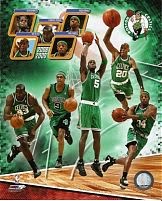
Celtics Jazz Quintet

The Celtics are b.ball players, but they are also a quintet. Like all musical ensembles, they are hit and miss. Creative in streaks, they are capable of long lapses in focus. Their grit is sometimes suspect, but they can bring it. And when they sync, they can blow. Here's how I see them: Rajon Rondo=Miles Davis Paul Pierce=Coleman Hawkins Kevin Garnett=Booker Little Kendrick Perkins=Charles Mingus Ray Allen=Big Sid Catlett I ain't gonna explain. Either you think I got it, or ya don't.