Top 50 Jazz Blog

Top 50 Jazz Blog
Showing posts with label vocal. Show all posts

Friday, August 22, 2014

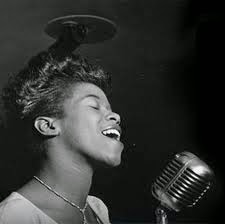
The Young Sassy

My personal predilection is for early to middle-period Sarah Vaughan. Her voice was golden from beginning to end, but I believe the amount of ornamentation she used later in her career sometimes overwhelmed the material itself. 

On this edition of the Duplex Mystery Jazz Hour (08/21/2014), I played only early recordings, starting with her first session in 1944 with the Eckstine band and ending in 1948, with her a cappella version of Nature Boy, which, at that time, challenged Nat Cole's version in popularity. 

Ballads dominate here. My take is that record producers wanted Sarah to crossover and thought this was the way to sell female talent (unless it was targeted to the "race" audience).

Go HERE to hear the show.

Billie Eckstine "I'll Wait and Pray" (1944) on Deluxe 
Dizzy Gillespie And His All Stars Quintet "Signing Off" (1945) on Continental 
Dizzy Gillespie And His All Stars Quintet "Interlude" (1945) on Continental 
Billy Eckstein Orchestra "No Smoke Blues" (1945) on Continental 
BIlly Eckstine and His Orch. "Don't Blame Me" (1945) on Spotlight 
Sarah Vaughan "Lover Man" (1945) on Guild 
Sarah Vaughan "What More Can A Woman Do"  (1945) on Continental 
Sarah Vaughan "I'd Rather Have A Memory Than A Dream" (1945) on Continental 
Tony Scott & his Down Beat Septet "All Too Soon" (945) on Gotham 
John Kirby and His Orchestra "Time and Again"  (1946) on Musicraft 
John Kirby and His Orchestra "I'm Scared" (1946) on Crown 
John Kirby and His Orchestra "You Go to My Head" (1945) on Crown 
John Kirby and His Orchestra "I Could Make You Love Me" (1945) on Crown 
Sarah Vaughan w. Dicky Wells' Big Seven "We're Through" (1946) on H.R.S. 
Georgie Auld and His Orchestra "A Hundred Years From Today" (1946) on Musicraft 
Sarah Vaughan w. Tadd Dameron "If You Could See Me Now" (1946) on Musicraft 
Sarah Vaughan w. Tadd Dameron "I Could Make You Love Me" (1946) on Musicraft 
Sarah Vaughan w. Tadd Dameron"My Kinda Love" (1946) on Musicraft 
Georgie Auld and His Orchestra "You're Blase"  (1946) on Musicraft 
Sarah Vaughan w. George Treadwell Orch. "I've Got a Crush on You" (1946) on Musicraft 
Sarah Vaughan w. George Treadwell Orch. "Everything I Have Is Yours" (1946) on Musicraft 
Sarah Vaughan w. George Treadwell Orch. "Body and Soul" (1946) on Musicraft 
Teddy Wilson Quintet "September Song"  (1946) on Musicraft 
Sarah Vaughan w. George Treadwell Orch. "I Cover The Waterfront" (1947) on Musicraft 
Sarah Vaughan w. George Treadwell Orch. "A Ghost of a Chance (I Don't Stand - With You)"  (1947) on Musicraft 
Sarah Vaughan w. George Treadwell Orch. "Tenderly"  (1947) on Musicraft 
Sarah Vaughan w. Ted Dale Orch. "I Can 't Get Started" (947) on MGM 
Sarah Vaughan w. Ted Dale Orch. "Love Me or Leave Me" (1947) on Musicraft 
Sarah Vaughan w. Ted Dale Orch. "I Get a Kick Out of You" (1947) on Musicraft [I didn't have much info on the Ted Dale Orchestra, so if anyone has anything interesting to say about them, please chime in].
Sarah Vaughan "What A Difference A Day Makes" (1947) on Musicraft 

Sarah Vaughan w. Earl Rodgers Choir "Nature Boy" from "Nature Boy" (Jazz, 1948) on Musicraft 

Wednesday, March 21, 2012

Jazz Makes a Standard

Pianist Robert Glasper said, in reference to The Great American Songbook: "It's time for a new standard. We can't do the old thing forever." Given the many attempts to bring jazz into hip hop or hip hop into jazz, I then posed the question: How far can you bend a standard before it breaks?  
Sung to the tune of Melancholy Baby: "Come to me my broken metatarsal"
Jazz has always been in the business of bending tunes. In fact, it seems completely reasonable to think that the Great American Songbook would be a much smaller part of American musical culture if these now "standard" tunes had not been plucked from their original Broadway or Hollywood context by jazz performers, who dug out and actualized their rhythmic, harmonic and melodic implications.

Going back to the 1920's, there were both vocal and instrumental jazz/pop versions of tunes originally used on stage and in film. Working alone, neither sung versions or instrumental versions could have done the job, but together they showed how a tune could be transmuted into a musical entity that transcended its initial conception and performance.


To see if this process unfolded in a way that is comparable to current cross-fertilization efforts between hip hop and jazz, let's look at how the process traditionally happened, using one of the great jazz war horses: "All the Things You Are."


With music by Jerome Kern and lyrics by Oscar Hammerstein, Jr. this song originally came from a show called "Very Warm For May." The history of the relationship between this tune and jazz is long and deep and also a little perplexing. All sources say the show opened on November 17, 1939, but according to Dr. Chalfen, there were two jazz-inflected versions recorded before that date: Tommy Dorsey's on October 20, '39 and Artie Shaw's, on Oct. 26. The sheet music says the song wasn't copyrighted until 1940, so maybe someone heard it in previews in Boston or New London and rushed out arrangements before the legal profession could stick its oar in. Sheer speculation.


In any case, this is the way Kern and Hammerstein conceived it to be performed in 1939 (as produced in a later re-creation):


The song was lovely in its fashion, but completely rooted in one particular era and style: Broadway Musical-shading-toward Light Opera. Kern marked the chorus a "Burthen," and "cantabile," (singable). These are archaic and/or fancified terms, reflecting Kern's roots in 1910's musical theatre. Withal, given its sophisticated harmony, it was clearly a song worth the attention of jazz people.


As noted above, in 1939, before the show actually opened, Artie Shaw recorded it with Helen Forrest. The first part (verse) was eliminated. There is a "classy" intro (big brass chords) before the low-down-ish piano slides in. Then, Shaw's clarinet chorus is a great illustration of how jazz claims source material and makes it its own. Forrest's vocal follows Shaw's lead. 


Although we're focusing on vocal transformations, we need to have an instrumental version, done in a style that would have been formative for any jazz vocalist. Here's Charlie Parker, with Red Rodney, Al Haig, Tommy Potter and Roy Haynes in 1949. 


This is Ella Fitzgerald in 1963, long after the song had been enfolded by jazz into its protean bosom. The tempo is up a bit, the background is more overtly jazz-like and Ella inflects the song all the way through. Even though Ella could handle a soprano range, the key has been brought down to take the gleam off and give it a darker feeling. When she picks it up after the instrumental, she completely alters the melody, then takes it home.


Through the years, various jazzmen wrote new melodies for the song's chord changes, including "Bird of Paradise" by Charlie Parker, "Prince Albert" by Kenny Dorham and "Boston Bernie" by Dexter Gordon. Charles Mingus retitled it "All the Things You Could Be By Now if Sigmund Freud's Wife was Your Mother." 

Addendum: Who first came up with what became the classic jazz intro for "All the Things You Are?" It's completely unlike the Kern verse. I'm thinking that Dizzy wrote it, but would love to hear from anyone who can spec this out. Thanks, Steve.

Sunday, August 22, 2010

The Voice and the Horn in Jazz--By Steve Provizer


Props to @JoshSinton for asking the question: "When did jazz musicians stop emulating singers and begin to emulate other instrumentalists?" It calls for more than a 140 character response...

The short answer is that they never stopped. It's an admixture and always has been.

Look at the popular music strains in America as they led to 20th century jazz. First, the vocal lineage. You're talking about minstrelsy, formal spiritual choruses with solos, theatre music, indigenous 'ethnic' folks songs, blues, shouts and 'parlor' singing, a la Stephen Foster. On the instrumental end, you had the banjo, guitar and piano accompaniment for that music. Then you had brass bands, pit bands, concert bands, plus the whole line of virtuoso pre-rag and ragtime pianists, as well as other instrumentalists whose enduring reputations bespeak a technical ability that clearly surpassed the norm.

For the sake of having to start somewhere, let's choose Buddy Bolden as the first (non pianistic) jazz exemplar of our premise. If I try to imagine myself back in that uncharted musical territory, standing in Bolden's shoes. it seems to me that the variations I played would be based on what I'd heard vocalists do, what I'd heard cornet or other (single-line) instrumentalists do and what the trumpet in my hands wanted me to do-what its technical parameters were.
From descriptions of his playing-and listening to the style of those who learned from him-Bunk Johnson, Freddie Keppard-what Bolden played was clearly elaborations on the blues and you know what? To this day, that's what horn players starting out continue to do.

The world ain't the same as it was then. The resources for anyone who would learn to improvise are like the difference between hitchhiking and climbing on the Space Shuttle. But were the decisions that Buddy Bolden had to make really that much different than the decisions anyone picking up the horn has to make right now-100 years later? We hear singers, we hear virtuoso instrumentalists. The instruments we play imprint themselves and create tendencies of interaction.

The human voice, for most of us, still has a compelling quality-and jazz pays homage to that through the truism that you can't play a ballad if you don't know the words.