Top 50 Jazz Blog

Top 50 Jazz Blog
Showing posts with label charlie mariano. Show all posts

Sunday, January 22, 2017

Boston and Beyond

The DuPlex on 1/19/17 welcomed back Boston jazz historian Dick Vacca.  For this "Boston and Beyond" show,  Dick brought in material that illustrated the early work of a number of Boston artists and how that work evolved (BTW, Dick's blog has an interesting salute to Nat Hentoff). Check out the playlist, then:

LISTEN HERE
Playlist
Makanda Ken McIntyre “Smax” Stone Blues (Prestige New Jazz 1960)

Hal Galper “Blues Theme” Single (Private recording 1962)

Hal Galper “Villainesque” Windows (Steeplechase 1975)

Bill Berry “Till You” Shortcake (Concord Jazz 1978)

Bill Berry “That Old Devil Moon” Jazz & Swinging Percussion (Directional Sound 1961)

Toshiko Akiyoshi, Charlie Mariano “The Village” Single (youtube 2007)

Toshiko Akiyoshi, Charlie Mariano “I’m a Fool to Want You” Deep in a Dream (Enja 2001)

Carol Sloane “In a Sentimental Mood" Live at 30th Street (Columbia 1962)

Carol Sloane “Deep Purple" I Never Went Away (High Note 2001)

James Williams “My One and Only Love” Everything I Love (Concord Jazz 1979)

George Wein “Exactly Like You” Single (youtube 1985)

Joe Gordon “A Song for Richard” Lookin’ Good! (‪Contemporary‬ 1961)

Teddi King “Oh, You Crazy Moon” Nat Pierce Orchestra 1948-1950 (Zim Records 1950)

Teddi King “How Long Has This Been Going On” This Is New: Teddi King Sings Ira Gershwin (Inner city 1978)

Tuesday, April 28, 2015

Pepper, Desmond and Shank


Not a law firm. Art Pepper, Paul Desmond and Bud Shank are white alto sax players who eschewed the hard-edged sound and harmonic approach of Charlie Parker. There were other well-known white sax players in the 1950's: Phil Woods, Joe Maini, Herb Geller and Charlie Mariano who, because of their approach and tone, fell more into the lineage of Charlie Parker. I'd call Gene Quill a borderline case, with one foot in each camp. 

To a large extent, Pepper, Desmond and Shank became the (alto sax) personification of the West Coast versus East Coast schism and represented a lightning rod for racial tension in jazz during the 50's and 60's (the New York-based Lee Konitz did also, but to a lesser degree).

This tension is a major subplot in Straight Life, the Story of Art Pepper. A fascinating read, Pepper's jumble of self-delusion, introspection and braggadocio is not the place to go for an objective examination of social issues. But, although clearly sometimes a prick, Pepper is convincing in his descriptions of the resentment that some black musicians felt toward him and the insults he suffered as a result of being white and playing jazz.

I'm not going to try and parse out the threads of the racism/reverse-racism issue–abandon hope all who enter there. But, there are some interesting questions that can be asked. Were there black musicians playing in this softer, non-Bird style? Were they not being recorded because of the same recording industry biases that prevented black bands from being recorded in the 1920's playing anything but "hot" music? Did group/political pressure keep black musicians from pursuing this avenue of creative approach? These white musicians seemed to be consciously trying to carve out a different musical space-was it inevitable they end up sharing so much of the same space, one that prioritized sweetness of sound, ballad playing, slightly less blues emphasis and the creation of melodic lines instead of vertical chord delineation? 

It would take hundreds of tracks to properly characterize how these guys sound, but I'll present a ballad and an up tempo performance from each to give a sense of their playing. First, ballads.

Art Pepper


Paul Desmond


Bud Shank (starts at :53)


And, uptempo.
Bud Shank (Cooper solos first)


Pepper


Desmond-(hard to find uptempo, rhythm-changes-type tracks like Scrapple)


My take: Pepper's tone is slightly more tart than the others. Desmond uses the most vibrato, then Shank and Pepper. In the uptempo tracks, a non-Bird approach seems to fall naturally under Pepper's fingers. Shank falls back more on Bird, but does find other pathways through the changes, albeit in a seemingly less natural way. Desmond's uptempo approach is all about the lines. It's more spare and he plays behind the beat more often. In sum, though, there is a very strong resemblance in their playing.

In any case, and broader cultural questions aside, I'm happy to hear any of these guys blow in a playlist that also includes hard boppers like Gigi Gryce, Cannonball Adderly, Sonny Criss...

As happens more and more often, the discussion about this post is happening not here, but on social media. If you want to read that discussion, go here. You're also welcome to leave a comment here.

Friday, January 10, 2014

The Sound of Boston Jazz: 1960-66


On the last Duplex Mystery Jazz Hour, I was joined by Dick Vacca, doyen of Boston Jazz history. The music in this show represents many of the threads running through jazz in that era-modal, hard-bop, swing-to-bop as well as the more venerable sounds of blues, lounge and big band. It includes some hard-to-find, indeed, some un-findable tracks. 

Here's the show:
Joe Bucci "Midnight Blue" from "Wild ABout Basie" (Jazz, 1962) on Capital 
Bill Berry Quintet "Manhattan Blues" from "Jazz and Swinging Perc." (Jazz, 1961) on Directional Sound 
Toshiko Akiyoshi Trio "Homework" from "Toshiko" (Jazz, 1956) on Storyville 
Toshiko Mariano Quartet "When You Meet Her" from "The Toshiko Mariano Quartet" (Jazz, 1961) on Candid 
Dave Lambert Singers "Individualist Waltz" from "Individualist Waltz" (Jazz, 1964) 
Charlie Mariano Quintet "To Taiho" from "A Jazz Portrait of Charlie Mariano" (Jazz, 1963) on Regina 
Joe Viola "Minor Mannerisms" from "Joe Viola Plays Manny Albam" (Jazz, 1959) on Berklee Records 
Rocky Boyd Quintet "West 42nd Street" from "Ease It" (Jazz, 1961) on JazzTime 
Roland Alexander Quintet "Orders To Take Out" from "Pleasure Bent" (Jazz, 1961) on Prestige 
Paul-Champ Three "Big Jim" from "The Paul-Champ Three" (Jazz, 1966) on Fleetwood 
Paul-Champ Three "Angel Eyes" from "The Paul-Champ Three" (Jazz, 1966) on Fleetwood 
Herb Pomeroy Orchestra "Woody 'n You" from "Woody 'n You" (Jazz, 1961) 
Woody Herman Orchestra "Mo-Lasses" from "Woody Herman 1963" (1963) on Mosaic 
Ken McIntyre "Curtsy" from "Looking Ahead" (Jazz, 1960) on Prestige New Jazz 
Woody Herman´s Orchestra "Jazz Hoot" from "Woody Herman 1964" (Jazz, 1964) on Philips 
Jes 2 "Our Love is Here To Stay" from "Our Love is Here To Stay" (Jazz, 1966) on arco 
Jaki Byard Trio "Cinco y Quatro" from "Here's Jaki" (Jazz, 1961) on Prestige New Jazz 
Sam Rivers Quartet "Fuschia Swing Song" from "Fuschia Swing Song" (Jazz, 1964) on Blue Note 
Jaki Byard Alan's Got Rhythm from "Live Vol. 2"1965 on  Prestige 

Tuesday, December 4, 2012

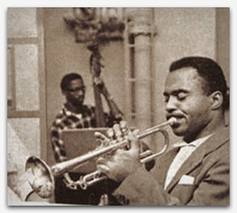
1950's Trumpets #3: Joe Gordon

Joe's one of our (Boston) boys. His career exemplified some of the larger themes of 50's trumpet playing: an early start, bop influence, big band experience, adaptability in various musical situations and on the down side: heroin addiction and early death.

Born 5/15/28, Gordon got early exposure to classical music through his mother, an amateur singer. He heard the Basie band, then a Coleman Hawkins/Don Byas group when he was a teen and signed on for a class in "modern music" at the New England Conservatory.

In his late teens, he worked on the railroads as a sandwich boy and jammed at various stops during layovers. His first formal gig was in 1947 with vibes player Pete Diggs in Akron(Pete Diggs?). 

Boston's main man Sabby Lewis heard Joe in Boston and invited him into his big band. Joe's name got out there and in 1951 he played his first recording session with Boston alto player Charlie Mariano. Though it's tempting, I won't play "Tzoris" ("Pack Up Your Troubles in an old Kit Bag").  I'll play the title track, "Boston Uncommon." Personnel is: Charlie Mariano (as), Jim Clark (ts), George Myers (bar), Joe Gordon (t), Sonny Truitt (tb), Roy Frazee (p), Jack Lawlor (b), Gene Glennon (d)

It's a nice arrangement, right out of Birth of the Cool and the sound developing simultaneously on the West Coast. Gordon's solo is well-articulated and constructed, with nice little vibrato flourishes at the end of some phrases.