Top 50 Jazz Blog

Top 50 Jazz Blog

Thursday, June 9, 2011

"The Trad Jazz Paradox"

I play trumpet in The Second Line Social Aid and Pleasure Society Brass Band- a group that plays (mostly) a mix of newer and older styles of New Orleans Brass band music. Call me delusional, but audiences seem to really like the antideluvian stuff we play. It animates people; makes 'em want to move and smile (the Saints) or get serious, if necessary (St James Infirmary).

This music may have a tinge of quaintness, but it is not "retro." It continues to have the core power to move.

OK, there are a few side factors:

-There are specifically funky tunes (Funkin' It Up, our version of Mercy, Mercy, Hurricane Season...)
-There's the oddity factor, as people just don't hear this stuff around here.
-Our reputation is that we play for good causes, not for the money.
-There's usually about 10 of us, so there's the sheer volume and chaos factor.

But that list doesn't really explain it.

Look at other tunes we do:
The Saints and St. James (of course), Bogalusa Strut, That's a Plenty, Just a Little While,  Riverside, Second Line, I'll Fly Away, Just a Closer Walk...


Ok, you can get persnickety about how purely trad it is, but essentially you are talking about old fashioned, analog, un-amplified, street beat/two beat music-with a banjo and no guitar. The harmony is basically blues or other venerable chord changes and the solos are appropriate stylistically.

A live presentation of horns and percussion is always vivid, but the trad style perfectly fits this instrumentation. In New Orleans, they know this and this style and instrumentation is the foundation for a constantly evolving tradition, as personified in so many young N.O. brass bands-Dirty Dozen, Rebirth, Hot 8, Free Agents, Soul Rebels...


And yet, people generally associate the phrase "Traditional Jazz" with cheesy straw hat & garter bands (c.f. Jack Webb in "Pete Kelly's Blues"), paunchy old guys (hey, I'm a skinny old guy), and musty 78's (send those right to me).

Is the problem bad P.R.? Do we need someone to make us hip? OK, but...

Friday, June 3, 2011

Revue: Roddy Doyle's Novel "Oh, Play That Thing"

Who actually says it on the recording is not a settled matter, but Jazz people know the expression from a recording of Dipper Mouth Blues:


Strange but true-I came to Oh, Play That Thing through a top-ten-best list of jazz books. It's a "picaresque" novel, a word once used to describe the work of J.P. Dunleavy or Henry Miller. Boiled down, it means there's a lot of screwing-and screwing up-by the main character. Author Roddy Doyle knows what he's doing and the writing is strong, but what particularly interests us here at Brilliant Corners is the relationship between protagonist Henry Strong and Louis Armstrong.

The two meet about halfway through the book, in mid-1920's Chicago. Henry Strong (a name that shows up in a lot of Doyle's writing) is an Irish revolutionary on the lam in the U.S. He's ambitious, handsome, tough and sexually hyper-active.

Strong is introduced to Armstrong by a paramour, Dora, who is passing for white so they can go clubbing on a non-Monday, otherwise the only night that non-whites are allowed in the big clubs. The first thing that Armstrong says when they meet is "That's a mighty fine vine, Pops." Then, half a page later: "An ofay that can carry a coloured suit-We got to talk, Pops."

So, clothes expedite the energy flow between them, but it's Strong's physicality and toughness that Armstrong needs and Strong becomes his gatekeeper--his White Man.

The author has assimilated Louis' writing style and listened carefully to his music and has his voice down pat. He also seems to have Armstrong's psycho-social situation down and expertly shows us Armstrong owning all the power when he's onstage and his relative powerlessness when he's off. Louis knows his own greatness, but understands the labyrinthine game he must play with white owners and management in order to prosper.


Strong is a kind of mirror image of Armstrong. Always at risk of being assassinated by gangsters or gunmen from his revolutionary Irish past, Strong cultivates the capacity to disappear, as Armstrong must cultivate the image of the responsible, obedient negro. At the same time, like Armstrong, Strong wants to be the one who rivets the attention of everyone in the room.

The book adeptly limns a kind of violent ballet between destructive and creative forces. For author Doyle, it's less ballet than high-wire act and, like an ofay that can carry a coloured suit, I think he pulls it off.

Thursday, June 2, 2011

Hang 'Em High

Don't let the movie "The Sting" fool you. Con artist are dirtbags who should be pulled apart by wild boars.


An elderly person who is quite near and dear to me has just been conned by a pack of these bastards; one of the many wolfpacks that run the mail-in "You Have Already Won" Sweepstakes. It's been both physically and mentally abusive and cost her a lot of money. 


She is the least greedy person I know and thought she could help her family. 

Oh, it was classic. She loves puzzles, so they started her off with an easy puzzle to do, and they kept sending her harder ones, telling her that only "X percent of people" have successfully completed this puzzle!" And, for good measure-"You're guaranteed to win something! To stay in the contest, just send us $$$. Remember, you've already qualified for a big money, but if you want a chance for the jackpot, you must send us $$$$."


THE BASTARDS!!


Then, when the time was right, they gave her a call. A woman, of course, to make her feel reassured. She says she's a "sweepstakes lawyer." The prize is going to be delivered by courier in the next couple of days. and DON"T TELL ANYONE ABOUT THIS UNTIL YOU GET OUR CHECK. The couriers are standing by-Just send cash by Western Union for the taxes (Western Union is complicit in this-they ask no questions about any exchanges. They probably get no information from any US Govt agency telling them who are running scams around the world. If they do, they ignore it. And make no mistake, these operations are frighteningly well-organized, sophisticated and international in scope).


When I found out about all this, and told them I knew it was a scam, they tried to switch the racket to EXTORTION for NOT TAKING THE PRIZE MONEY.


I'm not going to write about this in more detail right now, as my blood pressure is already soaring. I have contacted the Federal Trade Commission, the Postmaster General and the FBI and none of them give me much hope there will be any redress.


If you or your family has also been victimized, I'd be happy to hear from you-by comment or private email-to commiserate and to maybe think of a way to get our g.d. government to not just "take this seriously," but to actually do something to stop it, which they seem unprepared or unwilling to do.

Monday, May 23, 2011

"Tears, Performance and Dindi" by S.G.Provizer

Recently, a comment was posted in response to my piece about Abbey Lincoln and her intense song Throw it Away. "I'd like to sing it," the commenter wrote, "but I'm afraid I'd start sobbing onstage."


I immediately thought of the Antonio Carlos Jobim song "DIndi," as recorded on Wayne Shorter's 1969 LP "Super Nova." it is the only performance I know-live or recorded- which actually includes a performer crying. 


The first part of the track is percussion-mainly Brazilian-and soprano sax outbursts, which in no way prepares you for the vocal, which comes in at about 4:00. The vocal lasts about 3 minutes and the song ends with several more minutes of percussion and sax, alternatingly spacey and aggressive.


The vocalist is Maria Booker. Maria was bassist Walter Booker's wife and Shorter's sister-in-law. She was not a professional singer, but Bluenote producer Duke Pearson had heard her emotional version of Dindi. The accompaniment was just Walter Booker on classical guitar-a stark contrast to the other sections of Shorter's arrangement.


The lyrics of the song are fairly evocative and, indeed, from the beginning, Maria sounds deeply invested. As the song proceeds, she clearly becomes more and more emotional and barely manages to finish, gasping out the last few lyrics. Then, she starts sobbing softly. 


I heard Super Nova a few years after its initial release and my first response was shock. I felt Dindi was lovely, but was unsure if the crying was just a show-biz add-on. My willingness to release deeply into the song hung on whether or not I believed in the veracity of Maria's tears.  After a moment's hesitation, I bought in.


Now, so many years later, I read that Maria and Walter separated just after the recording. What seemed real, apparently was.


Wednesday, May 18, 2011

Whassup with the Jazz Blogs? By Steve Provizer

I'm seeing fewer and fewer comments on this blog and on all the jazz blogs I go to. Brilliant Corners continues to get about the same number of visits-around 300 a day and, with a mention on one of the "big" sites, can spike up to 500. But there is less feedback on what I write-no matter how many hits.

It's possible the decrease in comments in this blog is a result of my getting less and less interesting. Fair enough. However, when I look around at other blogs, the posts seem fairly consistent, while the feedback is also declining.

So, is this actual web-wide malaise? Is it confined to jazz blogs? If so, is it simply another in the constellation of "shrinking jazz audience" phenomena? Actually, I doubt that. My hunch is that the level of readership is stable.

I think there are two reasons why people comment: To tell their own story, or because they agree or disagree enough with a 'fact' or opinion to be motivated to write.

It's possible all the people who have a story to tell have started their own blogs. That leaves only motivation.

Sunday, May 15, 2011

The Late Night TV Big Band Litmus Test


The attention that used to be paid to jazz on such programs as "The Sound of Jazz," "Frankly Jazz,""The Subject is Jazz," "Playboy After Dark" and events like Clifford Brown on Soupy Sales show, jazz musicians "What's My Line," etc. petered out decades ago.

The late night big band managed to hang around a lot longer, but the recent passing of trumpeter Snooky Young, seen in the photo above and in this video with the Tonight Show Orchestra-struck me as the mortality marker for the 60-year relationship between big band jazz and television.

No longer will cameras spend valuable time scanning the band to show us the likes of Snooky, Clark Terry, Conte Condoli, Jack Sheldon, Ray Brown... And, apart from being able to see these musicians in the flesh, my guess is that it was also a boost to jazz record consumers, as a stable group of jazz musicians did not have to go on the road and could spend time in the recording studio. 

  Late night television carried over the radio idea that big bands were de riguer for variety shows. Late night was America's best well-known dirty-little-secret and the Tonight Show led the pack. While still riddled with taboos (a sketch wherein a WC was taken for a church was censored, leading to Jack Paar's walkout), sponsors were willing to pair jazz music with hosts who had vaguely "hip" credentials: Steve Allen, Ernie Kovacs, Al "Jazzbo" Collins (no hip creds except his name), Jack Paar and then Johnny Carson (In his early days, Carson had a fair whiff of disreputableness).

Merv Griffin (a big band singer himself) often guest-hosted, then got his own show and his big band was the West Coast version of the Tonight Show's until Carson moved out there in 1972. Big band vocalists Mike Douglas and Dinah Shore also had successful variety shows.


No doubt sponsors and producers thought that having a large band onstage gave the show some "klass," but, well, it did. It represented sophistication and a grown-up's hedge, if you will, against the onslaught of rock and roll. It also meant that any kind of a musical guest could be booked-tuba to musical saw-as solid accompaniment would always be there. This did lead to some very cheesy rock/jazz hybrids, but we won't go there.

I'm not saying that an anti-jazz stance became a litmus test for late night host survival. However:


David Letterman never cared much for jazz. His band (Paul Shaffer) and that of Saturday Night Live (Howard Shore, but it was really Lenny Pickett's Tower of Power sound on tenor sax) led the new musical way. Letterman may have been too far ahead of the curve, though, as Carson was a pretty staunch jazz fan and chose not to dub Letterman his successor. Dave shoulda feigned interest.

Jay Leno did and kept the big band thing going for a little while, Then, with Branford Marsalis, oversaw the band's mutation into the standard form funk-jazz that started to rule late night TV.

Conan O'Brien's band-Max Weinberg and company-was a hybrid, with a fair amount of swing; perhaps too much jazz in there for Conan to stay on a major network.

Now, who else ya got: Kimmel, Fallon, Ferguson. They might stick around awhile-no jazz.

I'll take a cup of Laphroaig then, for Auld Lang Syne.

Wednesday, May 11, 2011

Tout Ca Change at the FCC

This speaks for itself: Meredith Attwell Baker, one of the two Republican Commissioners at the Federal Communications Commission, plans to step down—and right into a top lobbying job at Comcast-NBC.


How is this acceptable? So far as I can see, my moral standards are not significantly higher than the average person. And yet, so much "business as usual" seems to be carried off on a level that would qualify for one of Dante's inner circles.

Friday, May 6, 2011

Live Group Recording-the Dave Lambert Singers Film


Just want to note the terrific 1964 D.A. Pennebaker film of the Dave Lambert Singers auditioning for RCA. Lambert was a very early practitioner of vocalese and bop vocals and, of course, a member of Lambert, Hendricks and Ross. The other singers are Mary Vonnie, David Lucas, Sarah Boatner and Leslie Dorsey, none of whom acquired a much larger reputation. Dorsey was killed driving a gypsy cab in 1988.

It's kind of extraordinary to hear 5 singers standing in a circle, all singing into a single mic, wearing no headphones. The singers make constant eye contact with each other, modulating their performances on the basis of a number of audible and physical signals, overt and subtle. The rhythm section plays in another side of the studio, with minimal sound baffling.

In the ongoing discussion about "live" versus "layered" recording (it is ongoing, right?), this film chalks one up for the naturalists.

Thursday, May 5, 2011

"Alice in Jazzfest Land-Pt. II" Steve Provizer

In Part I (see below), I vented about what I think is Jazzfest's ill-advised turn toward more BIG NAMES. In the spirit of generous top-ten-itude for which I am famous, here's a look at the more joyous aspects of the event:

1. The Jazz and Heritage Stage (Economy Hall), the traditional jazz tent. Here can be found a cohort of people who Second Line at the drop of a bandana. Black, white, young and real old, the bliss is palpable.
     Three Economy Hall highlights: Don Vappie and the Creole Jazz Serenaders' rendition of Skoodle-um-Skoo (2) Doreen Ketchens-if Louis Armstrong had been a woman (and played clarinet), he would be Doreen. 3) Leroy Jones-the guy is a m-f-er. What he was doing in the Trad tent, I don't know. He played "My Blue Heaven" and other similar tunes, but he is a hard-bopper.

2. Soft-shelled crab po-boys, mufalettas (both vegetarian and turkey), key-lime pie and Crawfish Monica.

3. Mist-ers in the jazz tent (could be more powerful and in more tents).

4. Seriously rockin' hybrids of Mardi Gras Indians and brass bands, esp Jockimo's Groove featuring War Chief Juan and Eric Gordon.

5. They show off the young folk who still blow the horns. NOCA has a lot goin' for it. Jeremy Davenport brought John Bradley, a protegee who is in the 8th grade, onstage. Somewhat frightening trumpet player.

6. More-or-less enough port-a-potty's.

7. The Gospel Tent (caveat: painful decibel level)

8.  People still be playing the blues-with passion.

9. Lagniappe Stage-eclectically, even brilliantly programmed.

10. I had no ticket for Saturday; had one for Sunday, but mistakenly brought an already-used ticket. Both days, I got in. Only in New Orleans.


I will be posting audio, including an interview with Doreen Ketchens, at allaboutjazz.com, so check that out in the near future.

Wednesday, May 4, 2011

"Alice in Jazzfest Land-Part I." by Steve Provizer

The New Orleans jazz and Heritage Festival (Jazzfest) is both blessed and accursed. It brings out both the Jazz Curmudgeon in me and the Jazz Booster. In this entry-the curmudgeon...

I hadn't been to Jazzfest in maybe a dozen years, my patience having been worn thin by the crowds and the limitations of the jazz tent, where people squatted all day, making it hard for those of us who liked to wander around and hear some gospel, Zydeco, etc.

The incursion of BIG ACTS started to jack up the size of the crowds, and back then, the acts weren't even that big-the Allman Brothers, Van Morrison. Now, they are. Bon Jovi, Wellenkamp, Robert Plant, Tom Jones(!), Kid Rock...

This is not a philosophical, moral or musical judgement on whether these acts should be there ("All music is folk music. I never saw no mule sing it"-Leadbelly). Vive la difference. But the presence of these acts and the throngs they draw affects the experience of everyone.


There may be upsides. First, fans of Kid Rock and co. almost certainly come into contact with other kinds of music, although it's a good bet the exposure will be at the outdoor stages, not in the tents that house jazz, blues, gospel, youthful players or very small ensembles. Second, more people get a job-even if it's standing for hours in the hot sun, waving a red flag to signal pedestrians to stop and let golf carts and trucks go by.

Much remains the same-good food, great local musicians-and I'll get to that in the next post. But the fact is, my overall experience was increasingly like America is and less like New Orleans is.

I ain't saying all is rosy on the streets of N.O. If you've been there, you know, but for better or worse, the place is different than any other city in the U.S. It's beautiful/ugly, wily, inventive and desperate. Even when it succeeds in being slick, there's an edge to it, always the sense that the whole thing may spill uncontrollably into the streets and end up in the local lockup.

Jazzfest is headed in the opposite direction. It's an entity whose demographics are increasingly appealing to larger corporations; the natural result of a growth spiral which favors the favored. It mirrors the growth of suburban pop concert venues twenty miles away and the demise of the corner bar.

Again, I'm not talking about some ineffable nostalgia. I'm talking about what sound the wind carries to your ears as you wade through the crowd, about having to look at thousands of people who agreed to put Shell Oil co. logo stickers on their hats and shirts so they might win some free gas and yes dammit, about people who wouldn't recognize a trumpet if you dropped one on their head.


Next time: The Upside: Misters in the Jazz Tent.

Tuesday, April 26, 2011

Walter Polite-A Bayou Working Man & Musician


I wrote this article about Walter Polite (pronounced Po-leet) for the Christian Science Monitor in 1997 and Walter died soon after. I reprint it here because I'm going back to N.O. and the memory of this bayou working man sitting on his front porch, grandkids running in and out while he played for me for hours, is one I'd like to summon up one more time...

NEW Orleans and the surrounding Louisiana countryside have proven as fertile in the generation of music as any region of the United States, perhaps the world. Jazz, Cajun, zydeco, and Mardi Gras music were all spawned here; Afro-Caribbean, gospel, blues, and rhythm-and blues have all flourished here.

To explore this legacy and especially today's Cajun and zydeco (“ZY- deco") music - a type of accordian-driven Cajun music blending blues and country idioms - I spent some time this spring in New Orleans and the bayou country, timing my visit to coincide with the New Orleans Jazz and Heritage Festival in May. This event, aside from presenting nationally- known acts, is a magnet for many of the area's crafts people, chefs, and, of course, musicians. I enjoyed the varied culinary specialties as well as the jazz and blues music, but I especially sought out the Cajun musicmakers.


Allen Fontenot, a Cajun fiddler and leader of a group called the Country Cajuns, recalled what it was like decades ago to be a young musician in local dance halls. Speaking in a patois that is itself a combination of ethnicities, Mr. Fontenot said, “You used to pay a quarter to get into the country dances and for that you’d get a live band and a big bowl of gumbo at 11. We used to call these dances 'fais dodo,' which means 'make sleep. You see, young couples would bring their little children to the dance, and they'd have to try and get them to go to sleep before they could party.”

While this kind of a dance is rare today, I discovered that the bayous and the country roadhouses that keep the music alive have remained pretty much the same for the last 50 years. Swamps dense with vegetation and squat cinder block or tin buildings with names Iike the "Half Moon” and "Coz's Blue Goose Lounge" still dot the countryside from outside New Orleans to Lafayette and New Iberia, “the heart of Cajun country."

It was on a trip to New Iberia that I met someone who personifies Louisiana's indigenous music culture. Walter Polite, born 75 years ago in St. Martinville, La., is a robust working man, who made his living as a laborer.

“I worked in the field, worked in the swamp, worked on the levee--all hand work," he said. "Never drove a tractor." There is something else that Mr, Polite does with his hands, and that is play the accordion masterfully.

We sat on the screened-in front porch of his small frame house, as three other generations of the Polite family listened or went about their business. He showed me some memorabilia and talked about his history with the accordion:

“My cousin went and bought a French accordion, but he couldn't play on it, so he gave it to me; said, 'If you can play on it, take it.' So I started to play; little dances, little parties, like that …Then I lost my child, and I stopped playing for about five years, Later on, some folks asked me to play for a dance, and I picked it up and started again."

It was clear that Polite didn't really enjoy taIking about himself and wanted to get down to more important business: "Now I'm gonna play you some music - some zydeco music.”
 
Technically, the instrument he plays is a triple-row diatonic accordion, but I was totally captivated by his playing and had no desire to analyze; the man and his music seemed totally unified. With his foot keeping accurate time, he played and sang, sometime in English, sometimes in patois French: "Hey Lucía," "Lena," "My Tutu," "Zydeco Cha Cha," and others.

"I don't say I'm the best." he explained, "but I try to satisfy the people." 

In the estimation of this visitor, he certainly does that.

Friday, April 22, 2011

"Boston Celtics Jazz Lineup" By Steve Provizer


Last year at the beginning of the playoffs, I posted my take on the C's as jazz musicians. The only change in this year's lineup is Shaq.


Rajon Rondo=Miles Davis
Paul Pierce=Coleman Hawkins
Kevin Garnett=Booker Little 
Shaquille O'Neal-Walter Page
Ray Allen=Big Sid Catlett


(Not to be used for illegal gambling purposes...If only)

Wednesday, April 20, 2011

"Operators Are (Still) Standing By" by Steve Provizer

Last summer, inspired by the alliance between Sony and the Miles Davis estate which offered a mouthpiece replica, t-shirts and other fascinating items, we created our own Louis Armstrong Simulacrum Kit. And, we couldn't keep 'em in stock!

Always eager to satisfy the insatiable jazz consumer, we have again forged a metaheuristic liaison with a clutch of Ukranian businessmen and created The Deluxe Charlie Parker Simulacrum Kit, which allows you to really "get next" this greatest of jazz improvisers. It includes:
  1. A dental x-ray showing Bird's "upper partials."  
  2. A yardbird wing from 1941, preserved in formaldehyde.
  3. A wheel from the band bus that probably crushed it.
  4. A bottle of Gordon's gin salvaged from the wreckage of the old Birdland, with a letter of provenance from Willy's Liquor Store on 44th St.
  5. An early brochure from the Camarillo Chamber of Commerce
  6. A box of Dean Benedetti out-takes (so unlistenable that even Ross Russell wouldn't release them, but still...)
  7. One oboe reed with a imbedded Mitch Miller moustache hair.


And, for the first 20 buyers, we will throw in shards from t
he cymbal thrown by Jo Jones in an infamous jam session incident (verification pending).

So act now. Our 'operators' are standing by.
And, as we always say, "it's not re-animation, but it's pretty damn close."

Friday, April 15, 2011

"Chet Baker Watch & Other Jazz Necessities," by Steve Provizer


Glad to see someone's finally designing a Chet Baker watch. If anyone says "be on time" to me, it's Chet.

Not to be outdone, I have a number of products in the pipeline:

Charlie Parker Day Planner
Trumbauer Guide To Linux
G.I. Lennie Action Figure
Joe Newman Sump Pump
Bill Evans Chest Expander
Keith Jarrett Beard Trimmer
The iTrane

Thursday, April 14, 2011

"The Shadow of Kitty Genovese" by Stephen Provizer


This is a re-written version of a post from last April, which I'm reprising as a pre-quel to a post later this week about the Occupy movement. I think it's timely.

I recently re-discovered the unusual Phil Ochs LP "Pleasures of the Harbor."  A song from that album, "Outside of a Small Circle of Friends," and another song from 1967-"All's Quiet on West 23rd," by a group called "Jetstream"-were inspired by a 1964 incident in Queens where the murder and rape of a woman named Kitty Genovese went unreported by neighbors.

The degree of passivity and non-involvement on the part of Genovese's neighbors is not clear (Good explanation here), but the incident inspired a flurry of research, which in turn generated a sociological premise called The Bystander Effect. The gist of this is that the larger the size of a group of people witnessing a "reportable" activity, the less likely any one person is to take action.

Friday, April 8, 2011

"Monk's Moods; a Look at Robin Kelley's Bio" by Stephen Provizer

Robin Kelley's massive bio Monk has been widely reviewed and justifiably praised. Monk's musical history is exhaustively researched and definitively outlined. Kelley's chapter on the early days of bop at Minton's and Monroe's is the clearest explanation of that confusing scene I've ever read.

But, when I read biographies, what most interests me is the interplay-the dissonances and congruences-between the art and the artist. The way this is undertaken determines where a biography is placed on the hagiography-to-'gotcha' spectrum.

In his Acknowledgments, Robin Kelley says he "did not want to write an authorized biography" and that Monk's son Toot, "...only asked me to do two things: 'Dig deep and tell the truth.' This is no small task, as Thelonious Monk may be the most enigmatic jazz hero of all. Kelley presents us with a ton of facts. It's up to the reader to decide whether or not we've been told "the truth."


Kelley's decisions about what to put in and what to leave out, what to emphasize and what to soft-peddle, play out palpably throughout the book. There seems to be no doubt that Monk was both a seer and a pain in the ass. He was a visionary and an egotist; a doting father and an absent one; a hard worker who turned it off when he felt slighted; a boss who said he "never fired anyone," but often replaced band members on short notice.

The story of Monk's drugs and alcohol use is often alluded to, but not deeply explored. This is an important omission, as much of what we think about Monk hangs on his biochemistry. I.e., when did he begin to get in the thrall of bi-polar-ism? To what extent are the episodes described caused by personal chemistry? Drugs? Some combination of the two? How much control might he have exerted over his drug and alcohol intake? Kelley tilts the moral ambiguity in favor of Monk, as one might emphasize a deceased uncle's intelligence over his biting sarcasm.

Kelley's failure to go more deeply into the "personal responsibility" aspect of the story is reflected in another way. Much is said to denigrate the media or other people's take on Monk as naive or child-like. But Kelley often purveys Monk as someone who is unaware that his odd behavior might make people think he's odd. On the other hand, Kelley often takes pains to tell us how aware Monk is of his surroundings and circumstances.

A biography may provide a means of self-reflection that can help us gain insight into ourselves. After all, deciding whether a book such as this tells "the truth" is less about facts than the reader's personal morality. But here, you get a bit of the same feeling you get with "embedded" war reporting. Living, eating, sleeping and facing bullets together affects what you choose to put in and leave out.

In this book, Robin Kelley has given us an amazing story, but we may need a slightly more detached scholar to help us through the dense psychic thicket that was Thelonious Monk.


Monday, April 4, 2011

Video Vault-Woody Shaw-"Bemsha Swing."

Another in the series of the great Woody Shaw, playing "Bemsha Swing," recorded by me on 8.21.85 at the Charles Hotel in Cambridge, MA.
Featuring:

Woody Shaw-trumpet.
Stanley Cowell-piano
David WIlliams-bass
Terri-Lyne Carrington-drums


Thursday, March 17, 2011

Japan & My Embouchure

There we are, in a nutshell. On a throne, with our feet in a pile of shit.

The vistas of unremitting destruction shake me to the core and my dreams are taken up with loved ones rushing away from white clouds of poison. Amid this miasma of empathy mixed with paranoia, the act of blowing the trumpet is completely self-indulgent and also necessary.

I brew and stew about catastrophes, but obsess about my embouchure. It's escapist, but imperative. It's not art "in the face of something" (You'd know that if you heard me). It's simply one other act of attempted self-definition which, in the face of crises around the world, is simply narcissism writ small.

Jazz and humor still remain central, but the gravity of recent days weighs upon us all, as well it should.

Friday, March 11, 2011

Collective bargaining: Threat or Menace? by Steve Provizer

You know the story: A guy is crawling on the ground looking for something under a lamp post. His friend comes up and says "Oh, is that where you dropped your wallet?" The guy replies," No, I dropped it over there, but this is where the light is."

So, America has dropped its wallet and instead of going off and finding some new source of light (solar-powered? cheap flashlight made in China? "alternative" media?) we are trying to find it under a lamp post that was bought and paid for by some very wealthy and powerful people. 

We actually have the choice to look elsewhere for our wallets (or for what you might call a reasonable explanation for our increasing impoverishment), but people seem to keep getting sucked into that highly controlled "staying-on-message" pool of light. What the hell is happening here?

Are we so much under the sway of the Myth Of Infinite Mobility that we continue to identify with the barons who are picking our pockets- the "winners" in our culture, the fulfillers of the myth? 

Have we come to a point that we believe so little in the intrinsic nobility of service to the community that the only people whose efforts we will support are those seeking a tax break so they can open a hog farm in a "right-to-work" state?

Does the Myth of the Rugged Individual hold sway to a degree that we have completely lost the sense of "there but for the grace of god go I?" and therefore hold no group responsibility for the fates of those whom fate did not bless?


Follow your dreams? OK, no problem, but please remember that our fates are intertwined. 

Also remember that just because you're paranoid doesn't mean you're not being followed.


Friday, March 4, 2011

"Ma Nuit En Enfer. Or, A Night at the Movies" by Steve Provizer

Hollywood movies suck. Not only that, going to a multiplex theatre is one of the most dispiriting, depressing and irritating experiences imaginable. Yet, it's one to which Americans are sado-masochistically drawn by the millions. It's especially piquant to plunge in just after you've seen the Oscars; like turning over a beautiful moss-covered log in the forest and having your hand covered with slimy larvae.

I had submitted to watching the Oscars only because I actually know a couple who made a movie that was nominated for best picture. I was curious to see someone of my ilk trying to pass in that glorious parade of narcissism, so I gritted my teeth and abided the endless car ads, the gruesome display of self-love and the singular lack of humor that marked the broadcast. A person's gotta ask: Does each winner really love his or her family that much? (actually, one noticed that it was only the men who gushed about that, not the women) And you know what else? Bob Hope was always stiff as a board. Finding 5 bits from him that were funny must have taken the editors half a day.

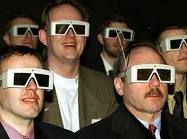
Right after that cavalcade of bonhomie, circumstances compelled me to transport my daughter to a multi-theatre gigaplex located in downtown Boston. The trip was necessary because video she'd submitted of herself singing one of Justin Bieber's  songs was chosen to get screen time in the "director's cut" (watch out Fellini) of his movie. It was about 2 seconds worth, as it turned out, but kudos to her. It was certainly Papabear's responsibility to get her there so she could strap herself in with the 3D glasses and bask.

I decided that the easiest thing would be to confer with my wife and find another movie that played at about the same time. It seemed a better alternative than drinking over-priced beer in the Theatre District for two and a half hours. Not the first time I've been wrong.

Walking in from the sidewalk, I knew immediately that we were in for an aesthetic treat. The interior of the place was right out of Albert Speers by way of Frederick's of Hollywood. The designers had managed to evoke mall anomie and blend it with the cheezy theatricality of Grauman's Chinese Theatre; all of it burnished with the accumulated grime of thousands of buckets of spilled popcorn smothered in "butter product."


Entering the theatre to see "True Grit" was like stumbling into a Mythbusters episode investigating how many decibels of sound it takes to induce diarrhea. We were forced to submit to half an hour of commercials and coming attractions-each of these pitched to 15 year old meth freaks. Bad in themselves, played at the volume level they were, they became instruments of torture. I'd paid Eleven and a half bucks to get the fillings shaken out of my teeth and have such of my hearing apparatus still remaining reduced to a distant tinnitus-tinged memory. 


I'll spare you a digest of the plot of True Grit. Initially, the experience was fairly pleasant, although the film's score was annoyingly Ken Burns-ish. However, as it went on, the characters more and more devolved into mere examples-albeit pristine examples-of "types." And, after the third bludgeoning, I asked myself how was it that crude, dismemberment/viscera-saturated violence had become so much the norm that it didn't even bear mentioning in film reviews?

While we're at it, someone tell me how many teachers can be paid union dues for the cost of one movie  ($300 million for "Avatar") and at what point filling out questionnaires at the end of a movie became electrodes strapped to your head.

No, my friend, the next time the latest "big" filmic release arises as a topic of conversation, you will find me curled up behind the couch with headphones on my head, a Rumpole in one hand and a Chateau Thames Embankment in the other.

Monday, February 28, 2011

Unions-Bah! What Are They Good For?

This past weekend, the motley musical crowd I play with-The Second Line Social Aid Pleasure Society Brass Band (SLSAPS)- played at a rally at the MA State House in support of Wisconsin unions-and unions everywhere(put into decent context here) and at a rally for the Student Farmworker Alliance and the Coalition of Immokalee Workers.

Maybe it was being around so many scrufulous people, or trying to play with frozen chops, but the whole weekend really turned around my attitude about unions. So, despite my ambivalence about such lists, I ask you to hearken unto my top 10 reasons why we just don't need unions anymore:
  1. No one's gonna tell me I can only work 8 hours a day.
  2. When my kid works, I want her to know the real meaning of money-no minimum wage for her!
  3. From 1990-2003, CEO salaries went up 272%, workers' went up 8%-definitive proof of basic Darwinian precepts (apart from Evolution, of course).
  4. Collective bargaining? Who came up with that idea? No matter how big or small the company, the CFO is always happy to individually negotiate your personal salary and benefits-and without any possible recriminations. Try it!
  5. I'm sure we would have had Social Security anyway.
  6. Workers in unions get 30% higher pay. Why should anyone without an MBA make more than me?
  7. If the average person made more, they'd just blow it on video games and condoms.
  8. Incomprehensible logos. 
  9. Calling each other "Brother" and "sister"- I mean, really.
  10. If left to their own devices, businesses-like banks-will certainly do the right thing by their workers.