Top 50 Jazz Blog

Top 50 Jazz Blog
Showing posts with label Jazz History. Show all posts

Friday, May 30, 2014

Jazz Underdogs and the Racial Tinge-Pt. 1


The history of jazz is complicated and resists a simple through-line narrative. It arose as a beautifully haphazard cross-pollination between musicians stable or itinerant, schooled or unschooled, making their work easier by creating songs and shouts, picking up tunes from brass and circus bands, listening in speakeasies and dance halls... All of this happening at dozens, probably hundreds of places across the U.S. 

Those would try to shape jazz into easy stories ("born in New Orleans and travelled up the river to Chicago" sound familiar?) need to keep in mind what Quantum Physics teaches us about measurement: nothing is static and the fact that you're measuring something changes its behavior. So, the observer can measure either its position or its movement, not both.


The commonest way to observe (i.e. freeze) the jazz story is through what I call the Jazz Hero approach; in other words, canonization. To make any canon viable takes historical buttressing, in the form of "experts" who produce books, collections of recordings, films, radio and television shows purporting to be historically "definitive."  The two most powerful recent examples were the Smithsonian Anthology of Jazz and the Ken Burns documentary. 

Jazz dissidents, who know that the Hero's shadow tends to suppress the work of other fine musicians and to over-simplify the process of creation, are always ready to undertake a critique of the canonization process. I've devoted a certain amount of space here and on my radio show The Duplex Mystery Hour to highlighting the work of musicians I think worthy of more attention: Miff Mole, Jabbo Smith, Charlie Shavers, Howard McGhee/Fats Navarro, The Roane Brothers, Joe Gordon and others. This a mixed race group, but much of the energy of the recent de-construction of the canon has gone into looking into the contribution of white musicians. I see it often on jazz Facebook groups and the leading example is Richard Sudhalter's book "Lost Chords, White Musicians and Their Contribution to Jazz 1915-1945." 
Is it a good idea to write jazz history by focusing on a particular race, gender, religion or other sub-group?  Does it accomplish the kind of democratization that "new" history goes after, trying to
uncover stories that are not restricted to important business and political figures or other historical "winners"? 

Yes and no.

I find Sudhalter's book rich and fascinating and it has led me to investigate a number of musicians in whose work I never invested much attention. It approaches the music with new, highly-trained ears and is a great repository of biographical details and new transcriptions. So, taken on its own terms, it exceeds expectations.

However, if the goal of re-examining this music is to try and more deeply probe its complicated fabric, then using race as the means of deciding who to focus on makes the book feel, well, oddly segregated. 

There are individuals both black and white not in the canon whose work should reasonably be set side by side for musical comparison. Also, the reason why a particular musician has been relegated to the back benches of jazz deserves a more sophisticated analytical lens than just race. 

An historian may, for example, assign people to "white" and "black" schools of clarinet playing in order to show first of all, that there were such schools and to show that the white school was undervalued historically. But, this 
arbitrarily truncates the analysis and seems more like ax-grinding about the maltreatment of a group than an interesting premise for musical re-examination. In fact, players were as subject to geographical influence as they were to racial influence. The individual trumps the group. If you can recognize the playing of Leon Rappolo, Johnny Dodds, Buster Bailey or Frank Teschemacher, it's because they sound different. 
Dodds
Rapollo
                     

Thursday, December 20, 2012

Jazz/Culture/Violence

Where does jazz fit in the post-Newtown discussion about violence and popular culture? 

While not really in the mix now, jazz has historically played the role that hip hop, some kinds of rock and video games now play. This short overview will look at mainstream perceptions of the relationship between jazz and "violence" and how that perception changed through time. 

Jazz grabbed a lot of pieces of American culture to create itself: field shouts, preaching, spirituals, minstrelsy, blues, ragtime, parlor music, brass band music. Further, most of those were, themselves, hybrid strains. 

Some of those influences, like spirituals, preaching and parlor music, self-identified as "genteel," or "uplifting." Some, like field shouts and hollers and blues, were labeled "slave music;" and were, by implication, "low." Minstrelsy and ragtime were associated with shakier morality-more urban, apt to indulge in "sophisticated" humor and often associated with houses of ill repute. Brass band music was energetic and its association with circuses(entertainment) reduced its moral tone. However, many of the trappings of performance-the military, the village green-were less suspect. Call it somewhere in between.

Each of these genres was also associated with the relative presence of, or lack of, violence. It's easy to see which was which.

By the turn of the 20th century, a music we now see as incipient jazz was being played by Buddy Bolden's group, Jelly Roll Morton and others. While it contained many musical influences, both "high" and"low," and was played at benign venues like parades and picnics, it was more closely associated with Storyville gut bucket joints, or the rough parts of cities like St. Louis and Memphis. Often described as wild and uncontrolled, the music was acquiring a specifically disreputable image.

Musicians in various cities were able to work both sides of the fence, playing improvisational music in joints and waltzes and quadrilles at balls and cotillions. With the unusual exception of James Reese Europe and the Clef Club in New York City, there was a racialist system which relegated darker-skinned musicians to gin joints, parades and lower-paying gigs, while whites or lighter-skinned creoles (in New Orleans) were able to work anywhere.

As the teens proceeded, there was more mixing among musicians and bands were expected to play many different kinds of "high" or "low-down" music, but by this point, jazz had provoked a serious moral backlash. Crusaders from many cultural niches helped to position it solidly as an anti-establishment music, associated with the demi-monde.

King Oliver and co. in Chicago
With the onset of Prohibition in 1919, jazz became anthemic for people flouting bourgeois norms. Bootleggers and other prospering members of the criminal class moved into the nightclub business and jazz was the music of choice. While merely a bystander, jazz became more specifically linked to violence, and moralistic, anti-jazz campaigns were common.

The backlash against Prohibition and its eventual demise in 1933 coincided with the rise of "swing" music. The cultural perception of jazz shifted and the music became less something to epater le bourgeoisie and more something you'd play on the jukebox in the malt shop. During WWII, the music "played its part," helped to sell war bonds and became even less associated with violence (any irony there?). 
The Connection
Post-war, jazz ran into more trouble because of its association with narcotics.  Mainstream perception, subject to the paranoia of McCarthy-ism and the patina of Eisenhower-era placidity, magnified the connection between jazz and a violent underworld. Still, it was not a monolithic public response. Rock and Roll records were being burned and benign public beatniks like Maynard G. Krebs were, like, acceptable to the masses.

By the 1960's, jazz moved toward a more centrist moral/cultural position. A wave of spiritualism, spearheaded by John Coltrane and wider adoption of the Muslim religion by jazz musicians had defused the jazz-violence connection. Also, rock was now clearly the music of the counter-culture.

In the following decades, the common perception of jazz, to the extent it was thought about it at all, changed little. Rock musicians remained the bad boys until they were supplanted by hip hop artists. Video games then joined them under the public microscope.

Even though jazz always had one (sometimes small) foot in elite social circles, it also talked about things that gentility-or hypocrisy-precluded as part of the cultural dialogue and which, at the least, had overtones of violence. So, while there are "political" dimensions to any outsider-minority-generated art, mainstream moral codes, at least in America, have always exerted more of a sanctioning influence over jazz than has The State. Even during the 1950's, when the narcotics-jazz connection was widely noted, the State Department sent jazz musicians around the world to try and help win the Cold War. 

The government has been too concerned with monitoring domestic political dissent and with its own overseas military campaigns, to pay much attention to the relationship of culture to violence on the home front. Even well-positioned crusaders like Tipper Gore have had a limited influence on government action. 

The debate has been dominated by the people with the loudest voice and the most money (the NRA, if you haven't figured it out), who have successfully reinforced archaic myths of rugged individualism and the right to the untrammeled arming of our populace.

Friday, December 7, 2012

A Look At "Why Jazz Happened"

There is much to fascinate here. It's rare to find a book with so much information which also reads so easily. Marginal Jazz fans will find a ton of material to interest them. Hard-nosed jazz-istas will too, but they may find themselves at odds, as I did, with some of the broad conclusions Myers forwards here.  

I admit up front that I tend to be uneasy in the face of someone else's certainty concerning musical/ historical constructs. Even a dizzying array of facts seldom nails anything down for me. Take the truism that artists reflect the times in which they operate: 
Easy to say, sez me, 
But much harder to prove specifi-cally. 

There are, for example, many jazz musicians born in 1985 who fashion their playing after bebop heros long mouldering in their graves. Maybe the fact that these musicians have heard hip hop or watched Dancing With the Stars is in there as part of their internal art-making process along with many hours of listening to Charlie Parker, but it's not so easy to parse out those influences. The process is always subject to conjecture, projection, bias, limited information; even with (especially with?) the words of musicians to back up your case.

On a larger scale, this is what Myers is trying to do in this book: anchor specific musical changes and content to historical, non-musical events. In service of this, he brings a laudable amount of research and scores of interviews, creating a book that is always interesting, sometimes enlightening, but occasionally too apt to push what is really conjecture into the realm of the authoritative.  


Myers gives us an interesting account of the reasons for the growth of L.A. after WW II and tries to tie those events to the onset of "West Coast" jazz. His chief witness is saxophonist Dave Pell, who clearly had a hell of a time, but I don't buy the case that tract housing developments, sunshine, beach, golf and the movie industry made specific musical things happen. Myers says: "The sound suited its surroundings, placing a new emphasis on instrumental harmony, fluid execution, and polished teamwork"(p.94). Hmm. If Gil Evans and the whole New York Birth of the Cool crowd wasn't fluid, polished, etc., who was? Myers also talks a lot about how L.A. separated musicians because distances, driving, running between studio gigs, etc. meant that there was much less hanging out in the kind of places that thrived in NYC. Is this also the kind of environment that would promote the sound of "instrumental harmony, fluid execution, and polished teamwork" noted above? Don't think you can have it both ways.

A clear tale is told here of how racism operated to close down jazz activity on black Central Ave. and provoke black musicians to move to the East Coast. But there are also enough stories in jazz folklore about racism in NYC, harassment over drugs, cabaret card suspensions, etc., that the idea of NYC as a racial refuge doesn't ring true; even more so because the book acknowledges that on neither coast did racism between jazz musicians seem to be a problem.

The section on how R&B affected jazz gathers much interesting information, but the underlying thesis is not convincing: hard bop as an attempt by jazz to "remain relevant" by infusing jazz with the beat and funk of R&B. Myers quotes Gene Seymour here: "Instead of grasping for greater complexity, hard bop provided jazz music with an innovative way of keeping things simple (p121)." I don't hear it in the music. Myers cites Elmo Hope, Horace Silver, Lou Donaldson, Clifford Brown, Miles Davis, Sonny Rollins and Benny Golson as hard bop composers. He says that hard bop had a "harder, more unified sound. (p.134)" and that it "added a back beat-a strong accent on the second and fourth beats of each measure(p.134)." I just can't buy it, even with Lou Donaldson kind of backing up the case. There were certainly some tunes that were more funky, but the predominating modality was instrumental virtuosity and a bop approach in the rhythm section. I can't see "Joy Spring" wooing away Earl Bostic fans. (It's cool, though, to learn that William Kunstler was the lawyer who helped Gigi Gryce incorporate to gain control of his music).

The chapter on the G.I. bill enabling a lot of musicians to acquire more formal music lifts a veil on the jazz-classical connection. I agree with Myers that formal classical training impacted jazz, but we disagree on what that specific impact was. Myers says that the result of this training was "a more complex form of jazz" (p.47). OK, if you're just talking about Third Stream music-and I see that music as more complicated only in terms of form, not improvisation. 

I think the major effect of this training was not that jazz itself became more complex, but that trained jazz arrangers were able to move into film and television work and to work with more popular artists on recordings. Examples: Buddy Collette, Teo Macero, Dick Hyman, Nelson Riddle, Henry Mancini, Andre Previn and Bill Holman. 


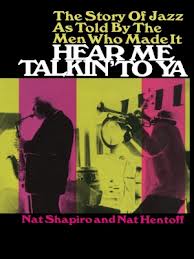
Jazzwax, Myers' blog, is superlative. It contains scores of interviews with musicians and music industry people. By putting many of his interviews in service here, Myers seems to want to make the tone of the book something in between just plain history and an oral history like Hentoff's "Hear Me Talkin' To Ya." But it sometimes begats a pastiche feeling. A sub chapter will start; you will see a quote; there will be a digression, then other quotes arise that recapitulate the start of the sub chapter, sometimes saying essentially the same thing. A story or a quote sometimes shifts chronology in a way that doesn't completely make sense. In the chapter on the rise of amplification in rock, we start out with Woodstock and go back to the mid 60's.  

The internationalist Indian and African aspect of John Coltrane's playing is referred to, as is Trane's few allusions to the civil rights struggle in the titles of songs. But there is no effort to explain the spiritual influence Coltrane had and still has on the music and the musicians. The interior voyage of a musician is fueled by an incalculable number of personal experiences and is not easily quantified. I think this is where the difficulty of relating musical processes to historical events comes home to roost. 

Does this mean I think it's a vain exercise to try and connect historical/technological events to musical content? Definitely not. There are conclusions here with which I take absolutely no issue-the ramifications of the Musicians Union recording bans of the 1940's; advances in recording-tape, the LP, the 45 and with amplification; Black separatism influences and others. If just as a gathering of information and oral history, Myers' effort is invaluable.

But wrapping things up into a too-neat theoretical bundle can be problematic. As with Dr. Frankenstein's efforts to create life, you can try and make sure that all the parts you put into the body are top grade and even then, there are no guarantees. You have to be ready to accept that your creation might pique the ire of restless villagers armed with pitchforks, torches and blogs (nothing personal, Marc).


Thursday, September 1, 2011

Jazz Evolution: Filling Up The Holes by S.G.Provizer

A recent post on Playjazz, a site with much to offer aspiring jazz musicians, said this:

This is why it's so important to listen to music from the whole history of jazz - because familiarity with the roots of the music allows us to hear the notes that aren't being played in later forms. Without knowledge of the earlier idioms, the brain is unable to 'fill in the gaps' when a modern musician implies certain material instead of stating it explicitly.

My reaction is that he kind of got it backwards. Jazz has evolved to fill up all the holes. Listening to the old stuff is imperative, but ironically, because jazz history has moved in a certain direction (more notes), it's natural for aspiring jazz players to want to jump on the continuum.
Lots of notes