

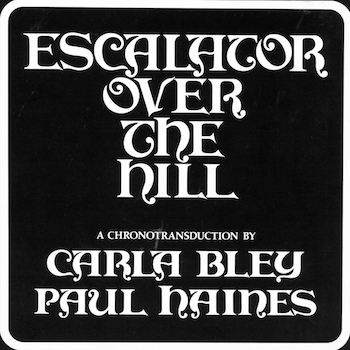
 Escalator Over the Hill (EOTH) distills a corner of the counter-cultural energy of the early ’70s. Politics is fodder for satire here, but the main theme is psychic disruption. This three-record set is a response to the question begged by the title: how effectual can any mundane machine be in o’ertopping the hill and reaching what lays beyond?
Jazz composer Carla Bley is the heart and soul of this recording. She describes the process of putting EOTH together as “run-and-gun” –a grassroots effort that took three years (1968 to 1971) to put together. No major label was interested, funding for the project was minimal, and participants included well-known musicians and people who, at the last minute, were literally pulled off the street.
EOTH is composed of a number of “scenes,” with different groups of instrumentalists and vocalists representing overlapping (and sometimes completely disparate) genres, from Kurt Weill-esque theater music, to free jazz, big band, rock, classical vocalizing, and Indian-like music. The actress Viva, of Andy Warhol fame, narrates. Jack Bruce appears on bass and takes the biggest load of male vocals. Don Cherry, John McLaughlin, Linda Ronstadt, and many others all have parts to play.
Although Bley and lyricist Paul Haines initially called it a “jazz opera,” there is no dramatic arc, per se. In the end, they labeled it a “chronotransduction.” “Chrono” is time, and “transduction” is a biological process where a cell converts one kind of signal or stimulus into another. The organizing principal here is the way the words of Haines are transduced by Bley into music. To some degree, the lack of dramatic impetus makes EOTH chaotic. But it’s sometimes a glorious chaos.
For my money, the composition works best when it doesn’t take itself too seriously. A lot of the libretto feels pretentious, and Bley’s responses sometimes follow in kind, weighing things down. However, when a lighter quality arrives and the libretto grows sparse, the results are enjoyable, sometimes even riveting. My favorite section is the “Desert Band,” which manages to evoke shifting sands, mirages, and oases. The group includes Bley (organ), Cherry (pocket trumpet), Souren Baronian (clarinet), Leroy Jenkins (violin), Calo Scott (cello), Sam Brown (guitar), Ron McClure (bass), and Paul Motian (doumbec).
Most of the album was recorded in one location, but sometimes, when musicians couldn’t make it to New York, audiotapes were shipped elsewhere for the dubbing of new tracks. It was a clunky process but, in a way, it presaged the coming digital era, when physical presence became unnecessary for international, even real-time musical collaboration.
Symbolic of the vibe of EOTH is that side six of the original LPs ends in a “locked groove.” The final track “…And It’s Again” continues infinitely on turntables. For the later CD reissue, the hum is allowed to play for almost 20 minutes before slowly fading out. Maybe that’s cheesy, maybe it’s not, but it is an artifact of the energy of the era.


