Top 50 Jazz Blog

Top 50 Jazz Blog

Monday, February 3, 2025

An Interracial Tune a Day (#8)-The Duke and Der Bingle

By 1932, Bing Crosby was already a hit on radio, and was beginning to make his way in Hollywood. Ellington was also a national figure because of his radio broadcasts and had made some short films. 

The Depression caused a major slump in record company sales, which severed relations with about 90% of the musicians on their rosters. Crosby and Ellington were about as sure fire a commercial combination as a record company could hope to put together. 

Duke's soloists stake out their singular territory, Bing does some great scatting at the end and this commercial pairing turns out to be a creative gem.

Duke Ellington and his Famous Orchestra: Duke Ellington, p, a, dir Arthur Whetsel, Freddy Jenkins, Cootie Williams, t / Joe Nanton, tb / Juan Tizol, vtb / Johnny Hodges, cl, ss, as / Harry Carney, cl, as, bar / Barney Bigard, cl, ts / Fred Guy, bj / Wellman Braud, sb/ Sonny Greer, Bing Crosby, v. New York, - February 11, 1932.

•  St. Louis Blues– vBC0: Br 20105, Col 55003, DOX-560, SW-290, Lucky 17005;

•  St. Louis Blues– vBC: Br 20105, 0116, A-5115, 20098 (Italian), Col 55003;

•  A Creole Love Call: Br 20105, 0116, A-5115, Col 55003;

•  Rose Room (In Sunny Roseland): Br 6265, 01292, A-9230, A-500174, Col DO- 1131

Here's Take 2 of St/ Louis Blues, which I slightly prefer over Take One.


All entries are from my book “As Long as They Can Blow. Interracial Jazz Recording and Other Jive Before 1935.”


Sunday, February 2, 2025

An Interracial Tune A Day (#7) An Early Very Mixed Group

Guitar/Banjo player Eddie Condon was one of the key innovators in putting together interracial sessions. He was a big fan of the Charlie Johnson Orchestra, one of the key groups in New York City in the late-20's-early 30's. He drew several members of that black group for this session and combined them with stellar white players.

Charlie Johnson's Paradise Orchestra

Eddie Condon

Trumpeter Leonard Davis is featured on "That’s a serious thing" and Jack Teagarden handles the vocal in his inimitable way. T. also solos on trombone and around 2'10" he plays a line that we will hear years later in "Stormy Weather." I wonder if Harold Arlen knew this track.

Eddie’s Hot Shots: Leonard Davis (tp) Jack Teagarden (tb,vcl) Mezz Mezzrow (c-mel) Happy Caldwell (ts) Joe Sullivan (p) Eddie Condon (bj) George Stafford (d) New York, February 8, 1929

•  I’m Gonna Stomp Mr. Henry Lee (jt vcl)- Vic V38046, Family (It)DP697, VJM (E)VLP55

•  I’m gonna stomp Mr. Henry Lee (jt vcl)- BB B10168, RCA LPV528;

•  That’s a Serious Thing (jt vcl)- BB B10168, Cam CAL383, RCA LPV528;

•  That’s a Serious Thing (jt vcl)- Vic V38046, “X” LX3005, HMV (E)B4987, (Aus)EA2970

On this video we get to hear both takes.

All entries are from my book “As Long as They Can Blow. Interracial Jazz Recording and Other Jive Before 1935.”

Saturday, February 1, 2025

An Interracial Tune a Day (#6)-Goodman and Hawkins

On February 2, 1934, Benny Goodman recorded with Coleman Hawkins. Not much need be said about these two Jazz giants. Before Coleman went to Europe, they played in a session put together by Columbia A&R John Hammond, who was a force for integrated recording sessions and who pushed to get Goodman to use black musicians. In 1935, Goodman played with (black) pianist Teddy Wilson in a trio, then brought in Lionel Hampton. 

We'll hear Georgia Jubilee in a nice arrangement by George Bassman.                          

Benny Goodman: Manny Klein, Charlie Margulis (tp) Sonny Lee (tb) Benny Goodman (cl) Coleman Hawkins (ts) Arthur Schutt (p,arr) Dick McDonough (g) Artie Bernstein(b) Gene Krupa (d) Mildred Bailey (vcl) George Bassman (arr) New York, February 2, 1934.

•  Georgia Jubilee– aAS- Cdl 2907-D, CB-759, Jay 10, JCl 528;

•  Junk Man– vMB- Col 2892-D;

•  Junk Man– vMB- Col 2892-D, CB-730, Tpl / Sentry 4003;

•  Ol’ Pappy- vMB / aGB- Col 2892-D, CB-730;

•  Emaline– vMB- Col 2907-D, CB-759, RZ G-22040, Jay 10, JCl 528


Thursday, January 30, 2025

An Interracial Tune a Day (#5)

There was a lot of recording activity involving black female singers and white musicians in the early 1920's. 

The Original New Orleans Jazz Band

The Original New Orleans Jazz Band followed in the wake of the success of the Original Dixieland Jazz Band (ODJB). It was one of the earliest jazz groups to be recorded and its members, also New Orleans guys, were either white or some degree of creole. Jimmy Durante was an original member of the group but had left by this point.
Lillian Harris

Lillian Harris was a powerful blues-vaudeville shouter.  Bio data about her is thin on the ground and she may or may not be the same person known as Sister Harris, or Estelle Harris.

Lillian Harris. Accomp. by Original New Orleans Jazz Band. Possibly Dick Landon or Ellsworth Evans, c; Andy Russo, tb; Sidney Arodin, cl; Allie Hamned, p; Tony DeRose, d; Lillian Harris, v. New York City, January 1923
  • 5051-2 Four O'Clock Blues (Johnny Dunn and Gus Horsley) Re 9445-B
  • 5051-3 Four O'Clock Blues (Johnny Dunn and Gus Horsley) Ba 1173-B, Re 9445-B
  • 5052-1 Sugar Blues (Clarence Williams) Ba 1173-A, Re 9445-A


Wednesday, January 29, 2025

An Interracial Tune a Day (#4)

I'm transferring my Interracial Tune a Day from my Substack to this blog. I felt that having my subscribers get a notice everyday for a new posting would be a little much. Let's hope the transfer is not too rough. If you're new to this blog, take a look around and please subscribe. There's a lot here. OK, on to business:

Red Allen

Pee Wee Erwin

I have nothing listed in my recording chronology until Feb. 2, so today I'm going back a few days to January 23, 1934- Henry Allen with Pee Wee Erwin.

Red Allen, a fine cornettist from New Orleans, was initially a Louis Armstrong acolyte, but he staked out new territory. His improvisations were more unpredictable and quirky and have even been characterized as avant garde. He was also an excellent vocalist.

Pee Wee Erwin was a powerful trumpeter who made his mark primarily as a lead player. He came from Nebraska and played in territory bands before he moved to NYC and became an anchor in the big bands of Benny Goodman and Tommy Dorsey.

The band's rhythm section (minus Luis Russell) are drawn from from Red Allen's New Orleans cohort.

In "It's Written All Over Your Face," Red has a brief intro, Pee Wee follows with a sedate muted solo, then Red comes in with a fabulous improvisation.

Henry “Red” Allen, t, v / Pee Wee Erwin, t / George Washington, tb / Buster Bailey, cl / Luis Russell, p / Danny Barker, g / Pops Foster, sb / Paul Barbarin, d. New York, January 23, 1935.

•  Believe It, Beloved– vHA- Ban 33337, Mt M-13304, 91940, Or 3087, Per 16071;

•  Believe It, Beloved– vHA- Epic LN-3252 (LP);

•  It’s Written All Over Your Face: Ban 33337, Mt M-13304, 91940, Or 3087;

•  It’s Written All Over Your Face: Mt 91940;

•  Smooth Sailing– vHA- Ban 33355, Mt M-13322, Or 3097, Per 16080;

•  Whose Honey Are You?– vHA- Ban 33355, Cq 8474, Mt M-13322, Or 3097, Per 16080, Ro 2471


All recordings drawn from my book As Long As They Can Blow. Interracial Jazz Recording and Other Jive Before 1935.


Friday, January 3, 2025

A Welcome and a Detour

Thanks very much for finding your way here. Please feel free to look around and check out past posts, of which there are many.

I also hope you will visit my Substack, where I've begun to do my posting. Substack is a great platform that really helps writers find their audience.  

I regularly also publish articles in Artsfuse.org and SyncopatedTimes.org. Great publications, well worth your time.


Sunday, October 13, 2024

The Worst Labels and Jargon in Jazz


Physicists are forced to concede that they can know either the location or the speed of a particle. They can't know both because the very act of looking changes the particle's behavior. 

The way scientists freeze frame electrons is the way categories have been imposed on every art form. In jazz, categorizing is a lazy shorthand that ignores the mutability of the music-and the musicians. Apparently, critics don't have the time to explain that Player X usually plays Standards and tends to improvise melodically, while player Z plays mostly originals, is less concerned with chord changes and more often plays modally. Instead we say this one is a "smooth jazz" player and that one an "avant-garde" player. Seldom does the fact arise that players change over their lifetimes, passing from one category to another-Grover Washington, Jr. and Donald Byrd, for example. 

Unfortunately, labels seem to have an unlimited shelf life. Once coined and adopted, generations of critics fall back on them and they stick like corroded trumpet valves. I grudgingly acknowledge their existence, but am happy to write about a few that particularly irritate me.

Dixieland Jazz. Cramming the music of the likes of Oliver, Keppard and Bechet into one category is ridiculous anyway. But with the relentlessly tenacious mythology of the Gallant South, the word 'Dixieland' grows especially egregious. The popularity of the Original Dixieland Jazz Band (ODJB) probably provided the impetus for its wide use and god knows their racial views were suspect. I know the phrase was taken up by Bechet and other black musicians early on, but if you say to me "Hey, it was good enough for Louis Armstrong to use," I would say it's probably a case of his understanding that on some occasions, using shorthand could make his life a little easier. Promoters of the phrase "Dixieland revival" latched onto a handy marketing device.

Be Bop. I guess it was good for branding purposes, as such catchphrases are in the world of commerce-Coca Cola, Alka Seltzer, Finger Lickin' Good. But the disparity between the serious nature of the music and the phrase attached to it is palpable. An exception can be made for the trickster Dizzy Gillespie, who was as serious as they come, but who knew how to work wordplay into the music (ooh bop she bam, etc.).

Hard Bop. A ludicrous title. There was no harder bop played-in any sense of the word-than that played by Bird, Diz, Fats Navarro and company. If anything, hard bop took its foot off the pedal more often than Bop.

New Testament and Old Testament Basie bands. I haven't found anyone who knows who pinned these labels on the Basie bands pre and after the early 1950's. Why it stuck, I don't know. I'm not saying that jazz is the enemy of the bible-although it certainly has often been seen this way. Let's just say I believe in the separation of church and the jazz estate.

Cool Jazz. First of all, all jazz is cool, no matter how hot it gets. Second of all, this label is used to differentiate East Coast from West Coast jazz, which is ridiculous. A lot of musicians were burning on the West Coast, while Miles, Gil Evans and company were creating the music specifically called Cool in New York City.

Neo Bop, Post-Bop, Neo-Swing. Putting neo- or post- in front of anything demonstrates a chilling lack of imagination. 

These locutions are now, happily, in the Dust Bin of History:

Licorice stick (for a clarinet). In the film "Song of the Thin Man", I actually heard Keenan Wynn refer to the instrument as a Jew Stick.

Skins/Tubs (for drums), Popsickle Stick (a reed player's reed). 

Hot Lick, Oh, Daddio, Real Gone, Wig Out, Solid Sent, Moldy Fig.

Tacking "-ville" on the end of anything, is, like, hicksville, dullsville, squaresville.


Tuesday, September 24, 2024

Smash Arts Akron: New Evidence Unearthed

The Institute

While this is not our first foray into interdisciplinary art exploration, we at the Institute are aware that our preoccupation with novel perspectives on jazz tonsure has left us open to charges of artistic parochialism. Our core mission of advancing jazz historiography remains intact. However, we made the decision to expand our vision and have undertaken an investigation into a phenomenon that has recently come to our attention: Smash Arts Akron. 

We are aware that graduate students in Harvard's Department of Museum Studies have been sifting through and dissecting the work forged in the studios of Smash Arts Akron, but even their rabid attention has failed to unearth a great deal of valuable cross-artistic detritus. Our own research has uncovered evidence of a hitherto unknown musical component of this visionary group. I'm proud to announce our preliminary findings.

The first evidence of an interdisciplinary aspect of the Smash group's opus arose from a close examination of the above photo. Notice that each person in the photo is looking in a different direction. In music, we call this a Polyphonic Grouping and its use has been traced to the early days of multi track recordings in jazz. The woman on the left is holding sheet music and electronic magnification shows watermarks identifying it as the original Dave Lambert vocal chart for the unreleased Gil Evans/Charlie Parker "Bird with Voices" recording.
Close examination of the above clearly shows that the subject of the photo is not drinking, but is blowing into the bottle; further, that he is using the one-handed bi-liter grip first employed by Lester Overholt on a 1928 Red MacKenzie Blue Blowers session. 

The above "objets," which we conjecture were carved by Buddy Bolden's first wife's brother-in-law, were part of a schema used in place of the Western musical notation system of notes, rests, and clefs. The 5-5-5 matrix was an allusion to the 5 square block area of the Treme Dstrict of New Orleans where the system was first developed. We speculate that the tops of the objects represent an nascent form of Tweeting.

The above is the unfortunate aftermath of an impromptu jam session organized by Sol Hurok, 
involving members of Smash Arts Akron and Charles Mingus.  


The complete results of our research are in the process of being peer-reviewed at the Journal of Jazz Epiphenomena and will be released on the final Tzolkin of the Haab.


Saturday, May 11, 2024

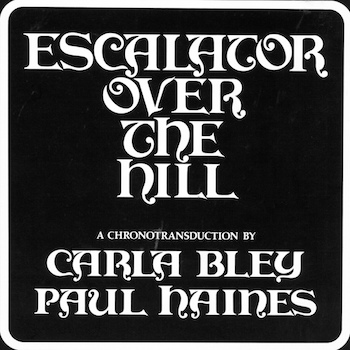
Carla Bley's Escalator Over The Hill


Escalator Over the Hill (EOTH) distills a corner of the counter-cultural energy of the early ’70s. Politics is fodder for satire here, but the main theme is psychic disruption. This three-record set is a response to the question begged by the title: how effectual can any mundane machine be in o’ertopping the hill and reaching what lays beyond?

Jazz composer Carla Bley is the heart and soul of this recording. She describes the process of putting EOTH together as “run-and-gun” –a grassroots effort that took three years (1968 to 1971) to put together. No major label was interested, funding for the project was minimal, and participants included well-known musicians and people who, at the last minute, were literally pulled off the street.

EOTH is composed of a number of “scenes,” with different groups of instrumentalists and vocalists representing overlapping (and sometimes completely disparate) genres, from Kurt Weill-esque theater music, to free jazz, big band, rock, classical vocalizing, and Indian-like music. The actress Viva, of Andy Warhol fame, narrates. Jack Bruce appears on bass and takes the biggest load of male vocals. Don Cherry, John McLaughlin, Linda Ronstadt, and many others all have parts to play.

Although Bley and lyricist Paul Haines initially called it a “jazz opera,” there is no dramatic arc, per se. In the end, they labeled it a “chronotransduction.” “Chrono” is time, and “transduction” is a biological process where a cell converts one kind of signal or stimulus into another. The organizing principal here is the way the words of Haines are transduced by Bley into music. To some degree, the lack of dramatic impetus makes EOTH chaotic. But it’s sometimes a glorious chaos.

For my money, the composition works best when it doesn’t take itself too seriously. A lot of the libretto feels pretentious, and Bley’s responses sometimes follow in kind, weighing things down. However, when a lighter quality arrives and the libretto grows sparse, the results are enjoyable, sometimes even riveting. My favorite section is the “Desert Band,” which manages to evoke shifting sands, mirages, and oases. The group includes Bley (organ), Cherry (pocket trumpet), Souren Baronian (clarinet), Leroy Jenkins (violin), Calo Scott (cello), Sam Brown (guitar), Ron McClure (bass), and Paul Motian (doumbec).

Most of the album was recorded in one location, but sometimes, when musicians couldn’t make it to New York, audiotapes were shipped elsewhere for the dubbing of new tracks. It was a clunky process but, in a way, it presaged the coming digital era, when physical presence became unnecessary for international, even real-time musical collaboration.

Symbolic of the vibe of EOTH is that side six of the original LPs ends in a “locked groove.” The final track “…And It’s Again” continues infinitely on turntables. For the later CD reissue, the hum is allowed to play for almost 20 minutes before slowly fading out. Maybe that’s cheesy, maybe it’s not, but it is an artifact of the energy of the era.

Wednesday, November 8, 2023

A.I. Reanimates the Beatles

The whole world-why restrict it-the entire universe-knows that the Beatles have released a song called Now And Then. This Frankenstinian effort was, as the YouTube P.R. says: “brought to life and worked on anew with contributions from all four Beatles.” The reconstruction entailed using AI to extract an old John Lennon vocal track and adding new musical backup.

Now And Then is probably the highest profile use of AI in popular music. It shows us that this technology can do something that couldn’t be done before: separate sounds that had already been mixed together. A machine-learning algorithm is trained to learn sonic patterns and create a neural network capable of isolating individual voices or instruments. It can then re-synthesize them to try and match samples of those instruments or voices. It took Lennon’s voice off the demo cassette tape and recreated it, giving us a sampled version of Lennon’s voice (and Harrison’s guitar).

My own view is that the song is maudlin and turgid; glib romantic tripe surrounded by white-bread music. Disclosure: I feel the same way about Let It Be, a McCartney song knee-deep in pseudo-religious semi-anthemic bathos. Worst of all, I never “got” Imagine. 

Now to something slightly more objective: the music industry is desperate. People don’t want to pay for music and for 15 years, album sales and music sales have declined. MRC Data, a music-analytics firm says that old songs represent 70 percent of the U.S. music sales. 

Record companies are plumbing their catalogues for music that can save their plunging bottom lines. But the real force in music is not record companies which are, in any case, a very small piece of very large international corporations. They are technology companies: Amazon, Google, Apple and Spotify, who own the download market. How many of these companies are out there looking for and signing new musical artists? None. It's no surprise that the music industry will use any tool it can to maximize its resources, especially if this tool simultaneously minimizes expenses.

I’ve read through a number of websites from in and outside the music industry. They acknowledge the drawbacks of AI (in a word: it’s not human), but overwhelmingly embrace the use of the technology. Here are some extracts to give a sense of what I mean.

As one website puts it: “AI can help with tasks such as music recommendation, content curation, and even music composition. By leveraging AI as a tool, the music industry can be at the forefront of the next wave of innovation.”

Another site says: “One of the most significant benefits of AI in music production is the ability to quickly generate new ideas and variations.”

A trope widely used is this: “It has democratized music production, making it accessible to those who may not have traditional musical training or expensive equipment.”

Another website states this “Con”: Because many people see music as such an innately human expression, it is often considered as too precious to impart onto technology. The thought of a computer generating a ‘random’ piece of music that hasn’t been painstakingly created by an artist is almost seen as sacrilegious.” However, a few paragraphs later, we read this: “Instead of shying away from the idea of this Black Mirror-esque future, the best approach to take is one of optimism and curiosity. While there are always bound to be diehard old school musicians who refuse to use tech, as there are readers who still refuse the Kindle, music producers should consider AI as something to be embraced.”

Another acknowledges this issue: “Moreover, while AI can generate music based on patterns and trends, it lacks the ability to understand cultural context and emotional nuance. Music is not just about melody and rhythm; it’s a form of expression that reflects the human experience. AI, as advanced as it may be, cannot replicate this aspect of music creation.”

It seems as though consumers of music are being asked to choose between an archaic “humanistic” attitude that rejects AI, or a “realistic” one which accepts, even appreciates it and, as the technology gets better and better, will narrow the gap between human and machine-made creation to indistinguishability. People will take sides on this and will impute moral and ethical judgements to buttress their positions.

It would be ridiculous to say the aesthetic application of AI falls into the life-or-death category of debates surrounding technologies like cloning, gene splicing or nanotechnology. Some of the debate is morally murkier, but some applications are obviously abhorrent. For example, as used in the streaming cesspool, to avoid having to pay money to flesh and blood musicians.

I love the Beatles. They were a force; born and fostered in an era when a group might make it past a second album that didn’t sell that well. In my youth, “Rubber Soul,” and ”Revolver” competed for turntable time with Miles, Getz and Coltrane. Now, rather than a generative force, they are a symptom of a systemic breakdown. The whole business is reminiscent of the holographic resurrection of dead musicians.

 It's only a matter of time before the Beatles get the Rod Stewart and Ella Fitzgerald treatment, which gives new meaning to the expression “half-dead.” Yes, pairing Rod and Ella is like putting Twinkie creme filling into a Godiva chocolate; like putting Donald Trump's hair on Sophia Loren's head. It shouldn't be conceived of. It shouldn't be done. But it has been, and it will.

Can anything be done? Those few musicians with real power might exert that power to force streaming companies to pay a fair share to artists. We might all demand those changes. We might also take note that the enemy is us and pony up for recorded music the same way we shell out for HBO, to see a movie, a show or a dance concert.

Tuesday, July 18, 2023

In Praise of Raspberries. A La Recherche du Fruit Perdu


Monsieur Proust is welcome to his madeleine. Those little cakes may have a rich provenance, but they are a rather wan substitute for more gorgeous desserts (crème puffs, chocolate mousse, etc). That a madeleine was transmuted by Proust to a “precious essence” can only be ascribed to a hypochondriac’s aversion to leaving his bed. If Proust had smelled and tasted the raspberries in my backyard, his prose would not only have risen to greater heights, he would have been a less dour mec and might even have moved out of his parents’ house.

But I have come to praise raspberries, not bury Proust.

First of all, each raspberry is unique. We’re told as children that no two snowflakes are alike, but all snowflakes taste, smell and look the same-except under a microscope, whereas the variations in size, color, taste and bouquet of raspberries are infinite.

Light pink when emerging, the fruit grows deeper in color, changing over the course of two weeks or so to a deep purple-red. Although a raspberry may be perfectly formed, don’t pick the fruit too early in the cycle. The bouquet is not developed and the taste somehow both flaccid and acrid. As the color deepens the taste and bouquet emerge.

Oenophiles speak of a wine’s “nose” and “body.” The word “raspberry” comes from a mid-15th century word raspise--"a sweet rose-colored wine" and all the complexities imputed to vintages from the Haut-Médoc may be found in this fruit. The bouquet and taste intertwine to create an experience that is pungent and regal; delicate and insouciant; subtle and stentorian.

A raspberry should be eaten in its natural state. Sugar and pectin are no friend to the raspberry, which does not translate well to jelly, preserves, even tarts. Freeze them if you must, but like a person with titanium implants who must respond to excess humidity, they will never be quite the same.

Unlike blackberries, when you pick a raspberry, it will come to your fingers without the central torus: hollow; with nothing pulpy to detract from the taste. When fully matured, the surface texture is pure velvet. A raspberry should yield slightly to the touch, but the tiny sections must cohere. Breeds of raspberries other than my own have many fine qualities, but tend to crumble in the hand, and no matter how quickly you shovel the pieces into your mouth, the experience will be disjointed, like listening to a stereo record through one speaker.

While Proust’s madeleines transported him to les temps perdue, eating raspberries anchors me in the present. It is one of the things in my life that effectively brings me here now. My bushes have yielded fruit annually for the last 20 years, making mid-July glorious even when the weather is not. I have done very little to help my raspberries prosper. Every spring, I cull the dead shoots; no fertilizer, no special watering or weeding.

With apologies to Matthew 6:28-33: Consider the raspberries of the field, how they grow; they neither toil nor spin; yet I tell you, even Solomon in all his glory was not arrayed like one of these.  


Tuesday, April 4, 2023

Booker Little "Out Front" (Recorded April 4, 1961)


The cohort of 1950s trumpet players is a pretty astonishing lot. Booker Little, one of that (often ill-fated) group, died of uremic poisoning at 23 and only recorded between 1959 and 1961. The album Out Front (released in 1961, now being reissued by Candid), is arguably the best recorded representation of his unique voice as trumpeter and composer-arranger. The lineup: Booker Little, trumpet; Eric Dolphy, alto sax; Julian Priester, trombone; Art Davis and Ron Carter, bass; Don Friedman, piano; and Max Roach, drums. All compositions are by Little.

From Memphis and schooled at the Chicago Conservatory, Little was a master technician on the trumpet. His unique tone managed to be both pleading and stentorian, copper and silver, focused but not excessively narrow. His varied use of vibrato, and of the extreme registers of the horn, together with his compositions, were the tools he used to investigate crucial, foundational aspects of jazz.

Although less bluesy/funky, there’s something of Charles Mingus in Little’s compositions, particularly in the stops and starts, along with the variations in tempo. I also hear similarities to the voicings used by Wayne Shorter in his arrangements, such as, for example, in Freddie Hubbard’s 1963 album Body and Soul. (Why so many Shorter tunes have become standards while Little’s are seldom played may be a result of the often through-composed structure of his compositions and, of course, the brevity of Little’s career).

Little was looking for a certain kind of freedom, but it was not the freedom of Ornette or of Dolphy, though they sound very natural playing side by side. Little’s idea of liberty called for more strictures. “Moods in Free Time” is a good reflection of this. The time here is not “free” in the customary sense. It derives its flexibility from a subtly crafted shifting of time signatures — from 3/4 to 4/4 to 5/4 to 6/4 meter.

The songs “Man of Words “and “Hazy Hues” are actually “program music” — a format seldom approached in jazz. The first is Little’s attempt to describe the journey of a writer confronting a blank piece of paper. Ideas are tested until a pattern emerges; at that point the real work has been accomplished. The second tune, almost a concerto for trumpet, limns a painter at work, starting with the germ of an idea and bringing it to completion.

Despite Little’s technical proficiency and knowledge of harmony, he considered technique less important than communication. Little said, “If you insist that this note or that note is wrong … you’re thinking conventionally–technically, and forgetting about emotion.…There are certain feelings that you might want to express that you could probably express better if you didn’t have that [bounding, continuous] beat. Up until now if you wanted to express a sad or moody feeling you would play the blues. But it can be done in other ways.”

Little’s oeuvre is distinctive and deserves wider attention. This reissue is an excellent place to begin to explore his very brief career. Don’t be surprised if you listen and two thoughts arise: “Why didn’t I know this music?” and ”What if…”